
-
Architecture
archive
art
Ballard
body
China
cinema
ecology
education
Europe
Ezra Pound
futurology
gothic
image
law
Literature
London
magic
memory
Modern
Modernism
museums
music
novel
performance
photography
poetry
politics
radical philosophy
science
science fiction
Sinclair
Situationism
sound art
Surrealism
technology
television
the avant-garde
The Future
Theory
thomson
time
Urban
visual culture
war
Posts tagged art
To mark the launch of Mnemoscape Magazine – edited by two former students at the IMCC – which coincides with the ten years anniversary of the publication of Hal Foster’s essay ‘An Archival Impulse’ (2004), the editors would like to prompt a reflection on the notion of the ‘anarchival’.
‘An Archival Impulse’ has establish itself as a seminal essay tackling the emergence of a specific archival tendency in contemporary art. However, as Foster noticed, this trend could perhaps be better defined as an ‘anarchival impulse’. The first issue of Mnemoscape Magazine would like to return to Foster’s early intuition and propose an epistemological shift in the study of archival art practices, one that privileges their anarchival disposition, while speculating on the positive and liberating aspects of forgetting.
Submissions are invited of single-authored or joint papers, interviews, reviews of art exhibitions and art projects that are concerned with the anarchival impulses. Send a 300 words abstract and CV to: mnemoscape@gmail.com Deadline: 30 June 2014

The next Group for War and Cultural Studies seminar may be of interest to IMCC followers:
Wednesday 19 March 2014, 6 pm – 8 pm, Room 156
University of Westminster, 309 Regent Street, London W1B 2UW
Monica Bohm-Duchen
Art and the Second World War
Art and the Second World War is the first book in English to provide a comprehensive and detailed international overview of the complex and often disturbing relationship between war and the fine arts during this crucial period of modern history. With ample illustrations, this talk will examine the art produced in reaction to the Spanish Civil War (often viewed as ‘the first battle of World War 2’), and then looks at painting, sculpture, prints, and drawing in each of the major combatant nations, including Japan and China. It will also place wartime art within its broader cultural, political, and military contexts while never losing sight of the power and significance of the individual image and the individual artist.
Monica Bohm-Duchen is an independent writer, lecturer, and curator. Based in London, she has worked for such leading institutions as the Tate, the National Gallery, and the Royal Academy of Arts. Her many books include After Auschwitz: Responses to the Holocaust in Contemporary Art. She teaches a course on art and war at Birkbeck, University of London, and at New York University in London.
Entrance free. To reserve a place, please R.S.V.P. Dr Caroline Perret: C.Perret@westminster.ac.uk
Archives for the Future: An Art and Visual Culture Conference, March 29
Tagged as archive, art, The Future, visual culture
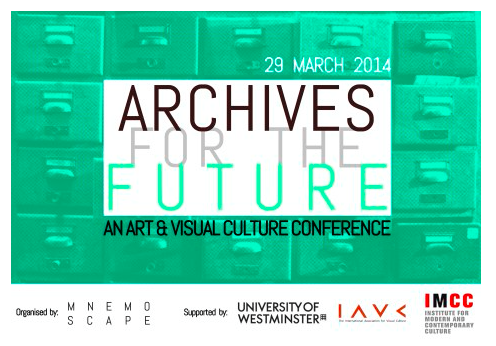
Saturday 29th March 2014, 9.00-5.00
Fyvie Hall, University of Westminster, 309 Regent Street, London W1B 2HW
Organised by Mnemoscape with the support of the Institute for Modern and Contemporary Culture and the International Association for Visual Culture.
Keynote Speakers: Francis Gooding (Birkbeck) and Uriel Orlow (Westminster)
Archives are becoming increasingly fetishized and (an)aestheticized in contemporary art practice and academic discourse. Archives have generally been considered as conservative institutions aimed at preserving the past in the present – and so perpetuating the traditional structures of power. In contrast, this conference is interested in bringing to light the generative and creative side of the archive. How can archives be used to generate the ‘new’ and to convey possible alternatives to the present status quo? How can we turn archives from historical records into instruments of future planning and agencies of radical thinking?
Full programme now available at: http://archivesforthefuture.wordpress.com/programme/
For any further information about the conference, please contact the conveners, Elisa Adami and Alessandra Ferrini at mnemoscape@gmail.com
Reading and Exhibiting Nature: An International Conference, Feb 7-9
Tagged as art, ecology, visual culture

February 7-9 2014
University of Westminster, 35 Marylebone Road, London NW1 5LS
Reading and Exhibiting Nature: An International Conference
In January and February 2014 Ambika P3, the flagship exhibition space at the University of Westminster, will present Out of Ice by visual artist Elizabeth Ogilvie. This new commission will involve environments created with ice and ice melt, constructions, films of ice systems, film of scientific expedition from Antarctica, and poetic film, much of it created through collaborations with Inuit in Northern Greenland, and reflecting on their deep and sustaining relationships with ice. The exhibition will portray the psychological, physical and poetic dimensions of ice and water and draw attention to ice processes. It will describe the presence of ice in the world from a human perspective in which the observational traditions of fieldwork will be combined with the artist’s trademark visual splendour.
In concert with the exhibition, the University of Westminster is convening ‘Reading and Exhibiting Nature’, a three-day conference examining how nature is being understood in contemporary cultural and artistic production. With a focus both in and beyond the polar regions, we will explore how artists and scientists are apprehending and representing natural phenomena, engaging with emerging non-human materialities and translating environmental data into aesthetic experience. The conference seeks to explore the shifting definitions of nature and how nature, including plants, animals, land, water/ice and weather inserts itself into human affairs and is represented culturally.
The ‘Reading and Exhibiting Nature’ conference is planned in association with the University of Westminster and co-hosted by Universities of Aberdeen and Edinburgh and Anchorage Museum, Alaska.
Keynote Address will be by Professor Tim Ingold, Chair of Social Anthropology at the University of Aberdeen
Full conference: Standard rate £200. One day rate £110; Student rate £90. One day rate £65.
Please see the draft programme and some hotel suggestions.
Autobiography and the Archive screening, Thurs 30th January
Tagged as archive, art, cinema, visual culture

A reminder of ‘Autobiography and the Archive’, a screening of work by Uriel Orlow, Miranda Pennell, and Sarah Purcell exploring the archive, collective memory, and personal history, curated by Mnemoscape for our regular partners at the Whitechapel Gallery and sponsored by the Institute. The screening is from 7-9pm on Thursday 30th January 2014, tickets £8.50/£6.50 concessions. Flier attached here: MS — Autobiography and the Archive (1).
The screening will be preceded by a drinks reception in the Creative Studio at the Whitechapel to celebrate the publication of the Journal of Visual Culture’s ‘The Archives Issue’. The special issue features contributions from Sas Mays and Marquard Smith, alongside Basel Abbas and Ruanne Abou-Rahme (with Tom Holert), susan pui san lok, Uriel Orlow, Chris Horrocks, Shezad Dawood (and Mark Bartlett), Nina Lager Vestberg, Gary Hall, and Trevor Paglen and Juliette Kristensen.
Reminder: Kreider + O’Leary, Jan 17th
Tagged as Architecture, art, cinema, visual culture

Kreider + O’Leary, ‘Ways to Cut the Earth Open’
Friday 17 January, 7pm
The Old Cinema, University of Westminster, 309 Regent Street
‘Ways to Cut the Earth Open’ is a cross-platform survey that examines a number of sites recently explored by Kreider + O’Leary in their nomadic practice. Using the sectional cut and the filmic splice as starting points they explore strands from their recent site-based works to thread together narratives of place and displacement. Predicated on an aesthetics of response while engaging with the complexity inherent in a given site, their work is both a form and act of communication: therefore, and necessarily, clouded by ambiguity. This prompts a critical investigation into the role of ambiguity for creative practices that relate to site, including writing and the moving image.
Kreider + O’Leary are a poet and architect who collaborate to make performance, installation and time-based media work in relation to sites of architectural and cultural interest. Since 2003, they have worked collaboratively to construct work in prisons, churches, military sites, film locations and desert environments, as well as in more traditional gallery venues across the UK, Europe, the US, Australia, and Japan. Their work ‘Light Vessel Automatic’ was exhibited at Performing Architecture at Tate Britain in February 2013. They are currently exhibiting a new work entitled ‘Edge City’ at the Lisbon Architecture Triennale.
Visit: http://www.kreider-oleary.net/
All welcome
Archives for the Future conference, March 29th
Tagged as archive, art, visual culture
Archives for the Future: An Art and Visual Culture Conference
Saturday 29th March 2014, 9.30-5.00
Fyvie Hall, University of Westminster, 309 Regent Street, London W1B 2HW
Organised by Mnemoscape with the support of the Institute for Modern and Contemporary Culture.
Keynote Speakers: Francis Gooding (Birkbeck) and Uriel Orlow (Westminster)
Archives are becoming increasingly fetishized and (an)aestheticized in contemporary art practice and academic discourse. This conference comes out of a shared sense of frustration at this. In response, it intends to explore the present and futuristic potential embedded in the archive. Archives have generally been considered as conservative institutions aimed at preserving the past in the present – and so perpetuating the traditional structures of power. In contrast, we are interested in bringing to light the generative and creative side of the archive, what Derrida has defined as its ‘institutive’ power. How can archives be used to generate the ‘new’ and to convey possible alternatives to the present status quo? How can we turn archives from historical records into instruments of future planning and agencies of radical thinking? Is it possible to build an archive which works as an open space of imagination and a mean of projection into the future? Is it possible to archive the future to come and, at the same time, to remain open to the unpredictable and the unknown?
Further details and programme at: http://archivesforthefuture.wordpress.com/
For more information about the conference, please contact the conveners, Elisa Adami and Alessandra Ferrini at mnemoscape@gmail.com
Salon#1: The Future of ‘Theory’ in Art and Design Education
Whitechapel Gallery, 77-82 Whitechapel High Street, London E1
Thursday 26 September 2013, 7pm – 9pm
Join Curator Kirsty Ogg, artist Uriel Orlow, and Head of Central Saint Martins Jeremy Till for the first in a new series of Whitechapel Salons debating the future of ‘theory’ in art and design education. Chaired by Marquard Smith.
Tickets £8/£6 concessions (£4 Members). Includes a glass of wine. Book your ticket here.
Co-organised by the IMCC and University for the Creative Arts
Call for Papers: Archives for the Future: An Art and Visual Culture Conference
Tagged as archive, art, The Future, Theory, visual culture

Archives for the Future: An Art and Visual Culture Conference
Organised by Mnemoscape and supported by the IMCC.
Call for Papers: Deadline submission: 18 November 2013
Archives are becoming increasingly fetishized and (an)aestheticized in contemporary art practice and academic discourse. This conference comes out of a shared sense of frustration at this. In response, it intends to explore the present and futuristic potential embedded in the archive. Archives have generally been considered as conservative institutions aimed at preserving the past in the present – and so perpetuating the traditional structures of power. In contrast, we are interested in bringing to light the generative and creative side of the archive, what Derrida has defined as its ‘institutive’ power. How can archives be used to generate the ‘new’ and to convey possible alternatives to the present status quo? How can we turn archives from historical records into instruments of future planning and agencies of radical thinking? Is it possible to build an archive which works as an open space of imagination and a mean of projection into the future? Is it possible to archive the future to come and, at the same time, to remain open to the unpredictable and the unknown?
We invite submissions that are concerned with reinstating the archive as site of political confrontation, of action and intervention in the present, as well as as site of re-projection and re-imagination for the future. We are particularly interested in creating a dialogue between theory and practice and as such we welcome contributions from artists, thinkers and curators alike.
To submit a proposal please send an abstract (300-500 words), a CV, five key words and a short biographical note (100 words). Please send in a single Word document to: mnemoscape@gmail.com
For more information about the conference, please contact the conveners, Elisa Adami and Alessandra Ferrini at mnemoscape@gmail.com
Death, Aesthetics and Representation, Wednesday September 11 2013
Tagged as art, Literature, photography, visual culture
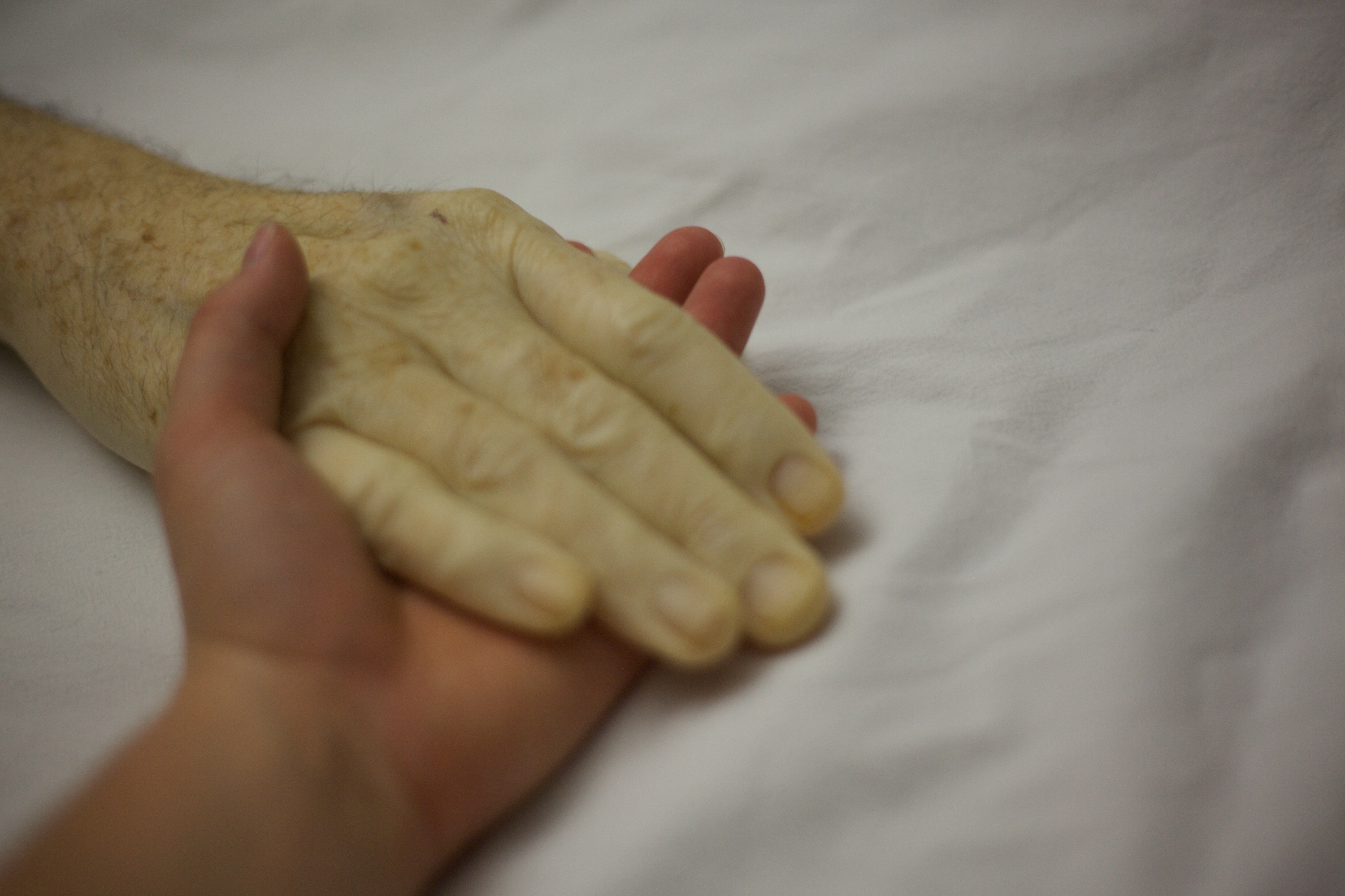
The final event in the series Death and the Contemporary, ‘Death, Aesthetics and Representation’ will take place on Wednesday September 11 from 7:00pm to 8:30pm, at The Photographers’ Gallery, 16 – 18 Ramillies St, London W1F 7LW, featuring contributions from a panel of keynote speakers including Professor Roger Luckhurst, Dr Timothy Secret, Audrey Linkman and Briony Campbell.
‘Death, Aesthetics and Representation’ is hosted by Georgina Colby in collaboration with Anthony Luvera. Through plenary discussions with keynote writers, visual artists and theorists, ‘Death and the Contemporary’ seeks to explore issues surrounding the representation of death in contemporary culture.
The following links contain further information about ‘Death and the Contemporary’ and ticket sales for ‘Death, Aesthetics and Representation’. Tickets for the event are priced at £7 or £4 concession.
http://thephotographersgallery.org.uk/death-aesthetics-reoresentation
http://www.deathandthecontemporary.com/
Citizen Curators exhibition, Photographers’ Gallery
Tagged as art, London, photography

‘#Citizen Curators’
July 1 – August 27 2013, The Photographers’ Gallery, 16 – 18 Ramillies Street, London W1F 7LW
How does social media transform the way we record, share and ultimately remember major events? #citizencurators is a Twitter project co-directed by our own Peter Ride which documents the way Londoners responded to the Olympics of 2012. It aims to show how the contemporary history of London 2012 could be recorded by the people who experienced it without the filtering of an institution.
In the project, any citizen of London could become a curator using social networking and tweet their responses in words or images with the hashtag #citizencurators. These were then collected and archived by the Museum of London. On the occasion of the first anniversary of the Games, The Photographers’ Gallery presents and reanimates the many photographs and tweets created by #citizencurators.
Further details at: http://thephotographersgallery.org.uk/citizencurators
Thomson & Craighead exhibition extended until July 13th
Tagged as art, technology, thomson, visual culture

Thomson & Craighead’s Never Odd Or Even has been chosen as Show of the Week in Time Out, which, in a review awarding the exhibition five stars, remarks that this ‘mini-survey makes a strong case for the duo being two of our most forward-looking and underrated artists’. The show itself has been extended until Saturday 13 July, so there’s still a chance to visit before the gallery takes an extended summer break until the next exhibition in September.
Their first ever survey show, featuring seminal works such as ‘More Songs of Innocence and of Experience’ (2012), and ‘Time Machine in alphabetical order’ (2011), Never Odd or Even also includes a new work that grows day by day: ‘London Wall W1W’ (2013) is the artists’ physical manifestation of Tweets drawn from within a one-mile radius of Carroll / Fletcher, which are then turned into propaganda-style posters and adhered to the gallery wall. Keep up to date with the latest tweets from W1W on @CarrollFletcher and tclondonwall.tumblr.com.
From 7pm on Wednesday 10 July, the artists are repeating the popular tour of the show they gave in June. Bookings can be made at carrollfletcher.eventbrite.com.
Foreclosure conference, June 17-18 2013
Tagged as art, law, politics, Theory, Urban

FORECLOSURE
Brunel University & University of Westminster
1st Joint Researching the Arts/Social Sciences Conference for Research Students
The Pavilion, University of Westminster, 115 New Cavendish Street, London
June 17 & 18, 2013, 10:30-5pm
Keynote: Oren Ben-Dor, University of Southampton
‘Placial [in]justice: reflections on the wounded origin of political affectation’
Please join us at this two-day interdisciplinary conference Foreclosure that aims to bring together law, art and politics. We understand foreclosure as the art of ordering and securing a common ground for the unfolding of a common experience; the exchange of affects and perspectives; and the performance of bodies and spaces. Art, Law and Politics habitually build walls around their concepts and practices. Foreclosure aims to encourage the exploration of practices and performances of law, art and politics through the prism of their shared operation; the investigation of the juncture between their disciplinary fences; and the unfolding of the fragility of their mechanisms. This is our aim: to dissect, dismantle and improve the operations of art, law and politics in order to locate cracks, produce apertures, and ride the lines of flight where new potentialities are generated. The conference programme is attached.
Admission is free but places are limited. RSVP at foreclosuresconference@gmail.com

Saturday 8 June, 3pm-5pm
Clore Creative Studio, Whitechapel Gallery, London E1 7QX
The Whitechapel Salon: Between Philosophy and Practice
We are pleased to announce a one-off Whitechapel Salon organised by the IMCC in collaboration with the Whitechapel Gallery and the Institut Français, London.
From the classroom to the studio, what is the status of philosophy in contemporary art teaching and practice? With guests Elie During, Stewart Martin and Jean-Marie Schaeffer. Hosted by David Cunningham and Marquard Smith (Westminster).
Elie During is Maître de Conférences in the Department of Philosophy at the Université de Paris Ouest – Nanterre La Défense. His publications include La Science et l’Hypothèse: Poincaré (2001), Faux raccords: la coexistence des images (2010), Bergson et Einstein: la querelle du temps (2013), and, in collaboration with Dominique Gonzales-Foerster, Donatien Grau and Hans-Ulrich Obrist, Qu’est-ce que le curating? (2011). He is on the editorial board of the journal Critique.
Stewart Martin is Senior Lecturer in Modern European Philosophy, Aesthetics and Art Theory at Middlesex University. He has published widely on Critical Theory, capitalism and philosophy, and contemporary art in journals including Mute, Oxford Art Journal and Third Text. He is a member of the editorial collective of the journal Radical Philosophy.
Jean-Marie Schaeffer is Directeur d’études at the École des hautes études en sciences sociales and Directeur de recherche at the Centre International d’Etude de la Philosophie Française Contemporaine. His publications include Petite écologie des études littéraires (2010), La fin de l’exception humaine (2007), Why Fiction? (2011; originally in French, 1999), Art of the Modern Age (2000; French, 1992), and, in collaboration with Nathalie Heinich, Art, création, fiction. Entre philosophie et création (2004).
Tickets £8/6 concessions (£4 Members). Booking is essential.
Book your ticket at: http://www.whitechapelgallery.org/shop/product/category_id/22/product_id/1644?session_id=13694768703e937a4cd471a409be17f1ad7f6d57df

Never Odd or Even
Carroll-Fletcher, 56 – 57 Eastcastle St, London W1W 8EQ
May 24 – July 6 2013
This is the first survey exhibition by Jon Thomson and Alison Craighead in the UK, bringing together a range of new and recent works.
Interested in how information about the world is filtered through the prism of the world wide web, and other forms of information technology, Thomson & Craighead play with this data to create poetic, compelling works that ask fundamental questions about what it is to be human.
Encompassing small-scale quotidian encounters, as well as works that point up the smallness of humankind in the vastness of the universe, there is a lyricism and lightness of touch that enables the artists to address major political and social themes from unexpected angles.
The exhibition is accompanied by a new publication with an essay by David Auerbach. The publication can be purchased from the gallery or via the online shop. The essay can be downloaded here.
China in Britain #5: Archiving, April 27
Tagged as archive, art, China, cinema, photography

Archiving: China in Britain #5
Saturday April 27th, 2013, 9:30am – 5:00pm
The Boardroom, 309 Regent Street, London W1B 2UW
10:00 ‘Shifting tastes in Chinese art: a history of the Berkeley Smith collection of Chinese ceramics at Cheltenham Art Gallery & Museum (1921-1958)’, Louise Tythacott (University of Manchester )
10:30 ‘Let’s talk about the money’, Helen Wang (Dept of Coins and Medals, The British Museum)
11.15 ‘The First Chinese Books in London’, Frances Wood (Keeper of China Collections at the British Library)
12:15 ‘Mapping An Archive of Chinese Representations in British Cinema’, Hiu M. Chan (University of Cardiff)
12:45 Title TBA, Katie Hill (Sotheby’s)
1:30 – 2:30 Lunch
2:30 ‘The Historical Photographs of China Project’, Robert Bickers (University of Bristol)
3.15 ‘Found In Time: My Shanghai Heritage’, Peter Hibbard MBE (Former President and Founder of the North China Branch of the Royal Asiatic Society)
3.45 ‘Maoist posters in London: A perspective from the University of Westminster’, Emily Williams (University of Westminster)
5:00 Drinks Reception
Romantic Transdisciplinarity: Art and the New
Tagged as art, radical philosophy, Theory
From our friends at the Centre for Research in Modern European Philosophy. Now Open for Registration:
Romantic Transdisciplinarity: Art and the New
May 8–9 2013
Senate House, University of London, Malet Street (http://goo.gl/maps/Sjkmr)
An International Conference about the transdisciplinary legacies of early German Romanticism in contemporary theory and practice in the arts and humanities. Organised by the CRMEP as part of its AHRC project on Transdisciplinarity and the Humanities in collaboration with the Institute of Germanic and Romance Studies, School of Advanced Study, University of London
Speakers include:
Howard Caygill (CRMEP, Kingston University)
David Cunningham (English, IMCC, University of Westminister)
Boris Groys (Slavic Studies, NYU)
Claude Imbert (Philosophy, ENS, Paris)
Gertrud Koch (Film Studies, Free University Berlin)
Olivier Schefer (Aesthetics, Panthéon Sorbonne, Paris 1)
Alison Stone (Philosophy, Lancaster University)
Hito Steyerl (artist, Berlin)
Peter Weibel (ZKM, Karlsruhe)
Registration is *REQUIRED* via: http://fass.kingston.ac.uk/activities/item.php?updatenum=2379.
Please note that the fees for the conference – waged £60.00; students & unwaged £20.00; Covers tea/coffee, the reception and lunch for both days.
Enquiries to: crmep@kingston.ac.uk
CFP: ‘Exhibiting Performance’, University of Westminster, London, 1-3 March 2013 – DEADLINE: 11TH FEB!
Tagged as art, performance

Confirmed Participants:
Franko B, artist; Steve Beresford, Performer and Musician, University of Westminster; Mel Brimfield, artist; Gavin Butt, Goldsmith College; Jon Cairns, Central St Martins; Maria Chatzichristodoulou, curator and performer, University of Hull; Tania Chen, Musician; Rob la Frenais, Curator The Arts Catalyst; Richard Layzell, artist, Middlesex University; Stewart Lee, writer and performer; Kira O’Reilly, artist, University of Hull; Marquard Smith, University of Westminster; Margherita Sprio, University of Westminster; Gary Stevens, artist; Tracey Warr, writer and curator, Oxford Brookes University; Silvia Ziranek, artist.
Exhibiting Performance Conference, 1-3 March 2013
University of Westminster, 309 Regent Street, London, W1B 2UW
The Centre for Research and Education in Arts and Media (CREAM) is convening Exhibiting Performance, a three-day event considering contemporary issues central to the display of performanceart. Following on from the Exhibiting Photography (2011) and Exhibiting Video (2012) International Conferences, this event will bring together notable artists, curators and writers, and provide a forum for a number of inter-related questions: On what terms has the rise of Performance in contemporary arts taken place? How do our museums and galleries disseminate and exhibit Performance? How does the live act of Performance inform questions around the body and the audience? How is Performance documented, archived and transacted? How does technology contribute to the development of Performance?
The conference will be framed by the exhibition of work by artists and writers responding to a live performance by Philip Lee and Cally Trench, Do you remember it – or weren’t you there? at London Gallery West, and Indeterminacy, a John Cage performance by Stewart Lee, Tania Chen and Steve Beresford.
There will be four half-day themes:
Curating: With Tate Modern opening the Tanks for performance events and Marina Abramovic’s major exhibition at New York’s MoMA in 2010, is performance art now mainstream, and on what terms? How do museums and galleries understand performance art?
Dissemination and Documentation: How is performance documented ? If you missed the performance is that it? What value does an art work in a different medium which gives a memory of a performance have?
The Body and Audiences: What is the role of the body in performance today ? Why do so many performance artists perform naked ? Is the naked body a sign of authenticity or does the taboo distract from meaning ? How is the relationship between artist and audience different from or similar to other areas of art?
Performance and Technology: How does technology mediate performance ? What are the ontologies of networked, mediated and recorded performance practices ? How is videoperformance ‘live’? How do different technologies of camera (webcam, surveillance, etc) and screens (CRT, flat, projection, mobile phone, computer, etc) change our concept of performance?
ABSTRACT SUBMISSION
Please send a 200-word abstract by 11 February, 2013. Successful applicants will be notified by 15 February, 2013. They must include the presenter’s name, affiliation, email and postal address, together with the paper’s title. Please send abstracts to Amanda Wheeler A.Wheeler@westminster.ac.uk
PROGRAMME AND REGISTRATION
This conference will take place from 4.00pm on Friday 1 March to Sunday 3 March 2013. The fee for registration will be:
Full conference: Standard rate £85. One day rate £50
Full conference: Student rate £40. One day rate £30.
Performance only: £10
This covers all conference documentation, refreshments, receptions and administration costs. Registration will open at the begining of February 2013.
EXHIBITION:
Do you remember it – or weren’t you there?
Philip Lee and Cally Trench
31 January 2013 – 3 March 2013
London Gallery West, School of Media, Art and Design
University of Westminster, Watford Road, Harrow
Middlesex HA1 3TP
PERFORMANCE
Indeterminacy, a John Cage performance
Sunday 3 March 2013, 6.30pm
Stewart Lee, Tania Chen and Steve Beresford
University of Westminster
309 Regent Street
London W1R 8AL
CFP: ‘Critical Cartography of Art and Visuality in the Global Age’, University of Barcelona
Tagged as art, visual culture

Our friends in the Art, Globalization, and Interculturality research group in the Department of Art History, University of Barcelona, are pleased to announce a ‘call for papers’ for their upcoming international conference entitled ‘Critical Cartography of Art and Visuality in the Global Age’. Please see further details below.
1st INTERNATIONAL CONFERENCE
Critical Cartography of Art and Visuality in the Global Age.
April 26-27, 2013, Barcelona, SPAIN
AULA MAGNA. Department of Art History, University of Barcelona (UB)
AUDITORIUM. Museum of Contemporary Art (MACBA)
The First International Conference Critical Cartography of Art and Visuality in the Global Age aims to engage with the complexities of the new status of art and visuality in contemporary art practice in the context of “globalization”. Focusing on the paradigms of identity, alterity, memory, locality and interculturality, as well as on new ways of understanding the political, ecological, technological, economical and scientific dimensions of the current age, the conference seeks to locate the topos from which each of these paradigms forges links between theoretical concepts and innovative work methodologies.
Scholars, artists, and research students working in the field of global art are invited to submit proposals for one of the following panel themes:
1. Media Art Documentation. New Tools for the Humanities.
Convenor: Carles Guerra, Keynote: Oliver Grau
2. The Utopian Globalists
Convenor: Anna Maria Guasch, Keynote: Jonathan Harris
3. Labor, Woman and Politics
Convenor: Juan Vicente Aliaga, Keynote: Angela Dimitrakaki
4. Art and the Post-Natural Condition
Convenor: Joaquín Barriendos Rodríguez, Keynote: T.J. Demos
Each panel will be comprised of four speakers, each allocated 20 minutes for their presentation, with the convenor encouraging debate among the presenters.
All abstract submissions (even if not selected for a panel presentation) will be considered for the publication Critical Cartography of Art and Visuality in the Global Age. New Methodologies, Concepts, and Analytic Scopes, an edited collection resulting from the conference to be published by the University of Barcelona.
A completed application form including a 300 word abstract and a brief CV should be submitted to Nasheli Jiménez del Val at artglobalage@gmail.com by February 18, 2013. Authors will be notified of acceptance for the panel, the publication, or both, by March 8, 2013.
http://artglobalizationinterculturality.com/activities/conferences/conference-2013/


The Institute for Modern and Contemporary Culture
University of Westminster Department of English, Linguistics and Cultural Studies
32-38 Wells Street, London W1T 3UW. United Kingdom.