
News
You are invited to the Private View of two exhibitions (including drinks reception):
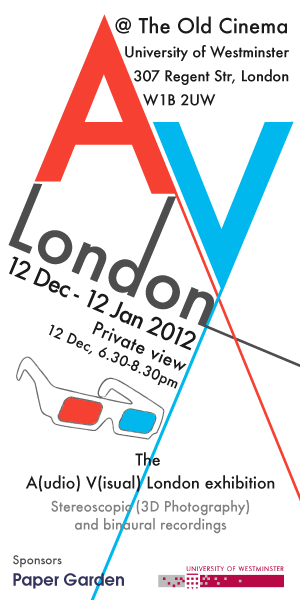
AND
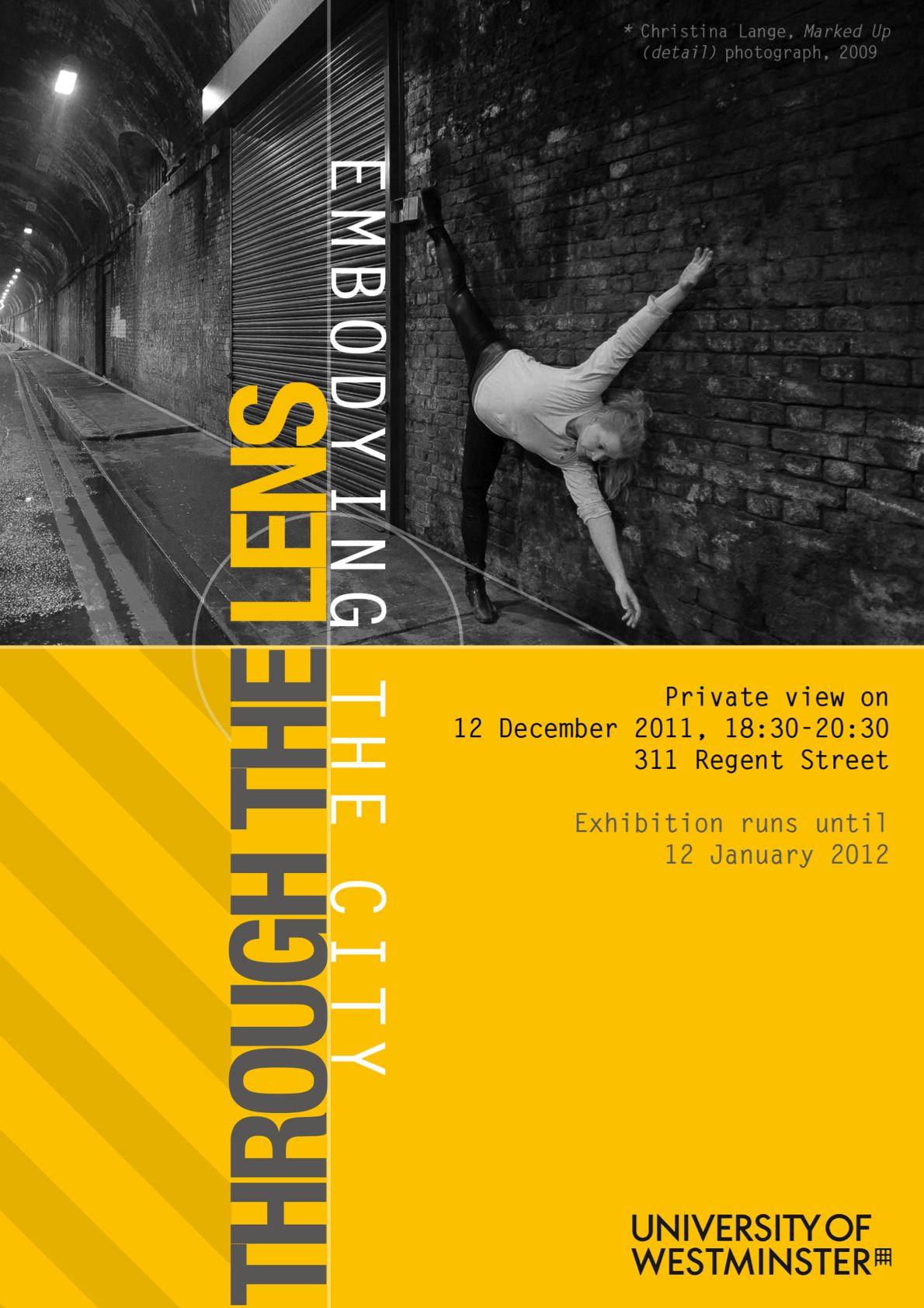
Monday 12th December 2011, 18:30 onwards
309 Regent Street Gallery, University of Westminster, London W1B 2UW
‘AV London’ and ‘Through the Lens: Embodying the City’ are curated by students on MA Cultural and Critical Studies, MA Museums, Galleries & Contemporary Culture, and MA Visual Culture, University of Westminster
Back in July, IMCC Visiting Fellow Dr Young-Paik Chun from Hongik University in Seoul programmed an event on Korean contemporary art on British soil at London’s Korean Cultural Centre. Details here.
Following the event, a report entitled ‘Situating Korean Fine Art Practice in a Western Context’ written by Dr John Cussans came to our attention. It is attached here, many thanks to John for making it available, and our apologies for the delay in posting it:

It is a pleasure to announce Dr Victoria Walsh as a Visiting Research Fellow at the Institute for Modern and Contemporary Culture, University of Westminster, for 2011-12.
As a Visiting Research Fellow and Co-investigator of the Tate research project ‘Art School Educated: Curriculum Development and Institutional Change in UK Art Schools 1960-present’, Victoria will be developing her work on the emergence and impact of practice-led research within the Institute. This position and partnership builds on Westminster’s longstanding collaboration with the Tate across research and programming including the current collaboration on the MA Museums, Galleries and Contemporary Culture and the Johns Hopkins Summer School programme.
Victoria is also Visiting Research Fellow in the Arts and Media Department at London South Bank University which builds on her role as Co-investigator of the AHRC funded-project ‘Tate Encounters: Britishness and Visual Culture’ (2007-10) which was led by LSBU, and includes the completion of the project’s publication Post-critical Museology: Theory and Practice in the Art Museum (Routledge 2012).
Prior to this, Victoria was Head of Adult Programmes at Tate Britain (2005-11) where her work spanned both the Research and Learning departments. Previously, she worked as a freelance curator, project manager and research consultant in the fields of visual arts and architecture including the project-management of the competition to select an architect for Tate Modern, the relaunch of the Fourth Plinth Project in Trafalgar Square for the Mayor’s Cultural Office, and as Curatorial Consultant the exhibition ‘Open Systems: Rethinking art since 1970’ (Tate Modern, 2005). She holds an MA in Art History (Courtauld), in Curating (RCA 1995) and a doctorate on the artist Whistler (Oxford Brookes 1996) and has published on post-war British artists Nigel Henderson, Francis Bacon, Gilbert & George and architects Alison and Peter Smithson. As Programme Consultant on the 5th Year Diploma Course ‘History and Theory’ at the Architectural Association she is currently teaching the ‘The Independent Group: Tracing the Parallels in Visual and Urban Culture’.
We really do look forward to working with Victoria in the forthcoming year.

Our friends in the Africa Media Centre at University of Westminster, in conjunction with London African Film Festival, are organizing a conference entitled: ‘Women and Film in Africa Conference: Overcoming Social Barriers’
Saturday 19 and Sunday 20 November 2011
University of Westminster, 35 Marylebone Road, London, NW1
Confirmed Keynote Speakers:
Jihan El-Tahri is an Egyptian-French writer, Director and Producer of Documentary films. Her award-winning films include documentaries filmed in the Congo, Angola, Zambia, Tunisia and other parts of the world, including Saudi Arabia. Her latest film Behind the Rainbow deals with the transition of the ANC from a liberation organization into South Africa’s ruling party.
Yaba Badoe is a Ghanaian-British documentary maker, journalist and novelist; she is a visiting scholar at the University of Ghana. Her directing and producing credits include the award-winning documentary The Witches of Gambaga the story of a community of women condemned to live as witches in Northern Ghana.
“Women and film in Africa: Overcoming Social Barriers” is the exciting topic of the University of Westminster’s Africa Media Centre’s next event to be held at 35 Marylebone Road, London from 19-20 November 2011. It will deal with the contemporary and historical role played by women in the film, television and video industries in Africa. From Arab North Africa, West Africa, Central and East Africa, through to Southern Africa, women have emerged from the double oppression of patriarchy and colonialism to become the unsung heroines of the moving image as producers, directors, actresses, script writers, financiers, promoters, marketers and distributors of film, television and video in postcolonial Africa. Sadly, such immense contributions by women are underrepresented, both in industry debates and academic research. There are now many cases in which African women in front of and behind the camera have overcome social barriers, yet this is often sidelined. This conference delegates will include students, practitioners, academics and researchers to debate how women have contributed to film, television and video markets in Africa from the pre-colonial, colonial and postcolonial eras. It is expected that the event will help focus existing industry and academic work on the ways female audiences in Africa have engaged with film, television and video texts. The conference will include a session with leading female filmmakers.
REGISTRATION IS NOW OPEN
Full conference: Standard rate £135. One day rate £95
Full conference: Student rate £55. One day rate £40.
Fees cover: conference pack, lunch, coffee/tea, a wine reception and administration fees.
Please follow the link: http://www.westminster.ac.uk/news-and-events/events/2011/women-and-film-in-africa-conference-overcoming-social-barriers
Another fine video from the Institute’s AHRC Research Fellow Joe Banks (Disinformation):
Film copyright © Joe Banks & Poulomi Desai 31 Oct 2011
Headphones or external loudspeakers essential
The Canadian psychologist Albert Bregman’s theory of Auditory Scene Analysis describes how the human mind is able to identify, focus on, isolate and extract streams of actually or potentially meaningful sound information, which it recognises as emanating from discreet sources, using analysis of what amounts to the musical content of specific “melodic streams” within environmental noise. In terms of evolutionary biology, the theory suggests that our capacity for appreciating music may have evolved at least in part as a by-product of the mechanism that enables us to identify sound-streams that come from, say, a distant river, particular types of bird-song, or the call of a potentially hostile predator etc; and in human communications this faculty is most obviously in evidence as a contributory factor in enabling us to perceive individual speakers in crowded social environments (the Cocktail Party Effect). In terms of everyday experience, the isolation of such streams may seem deceptively simple, but in information theoretic and signal processing terms, the level of computational power required to extract such invariants* from the distorting influences of complex and rapidly-changing real-world sound environments still challenges engineers and computer scientists. Problems associated with extracting invariants from noisy environments are of particular relevance to air traffic control, military fighter and helicopter communications and battle management systems. Generalities aside, the soundtrack used in the Disinformation + Usurp “Sun Rays” film is a direct recording of the real sound-ambience of the film’s location, “composed” using sharp graphic-equalisation only, to reproduce the subjective experience of the melodic streams that were perceived in the extraordinarily atmospheric ambience of that underground space (and, totally coincidentally, the title of this film, which is taken from the footage itself, is also the name of the Indian Air Force military aerobatics demonstration team).
Filmed in New Delhi, Oct 2011. (J. Banks, IMCC Westminster, 1st Nov 2011).
*The term “invariant” was coined by the American psychologist JJ Gibson
First Blip Prize for Creative Technologies
Tagged as technology, Urban, visual culture
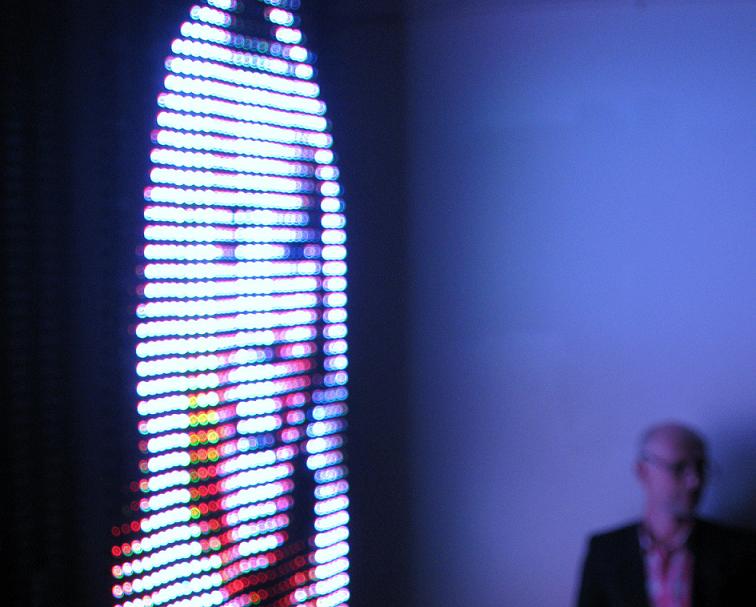
We are pleased to report that the winner of the first Blip Prize for Creative Technologies was announced last night. The prize is awarded, courtesy of Blip Creative, to the best student project design for the IMCC’s new public display screen at Wells Street. The 2011 winner was Sophie Meter for her beautiful butterfly animation. Runners up were Kristian Agustin, Eleni Tziourtzia, David Itzcovitz and Yen Ooi. The winning videos can be seen (when opened in firefox) at http://www.blipcreative.com/blog.html Or, of course, you can check them out live on the corner of Wells Street and Booths Place.
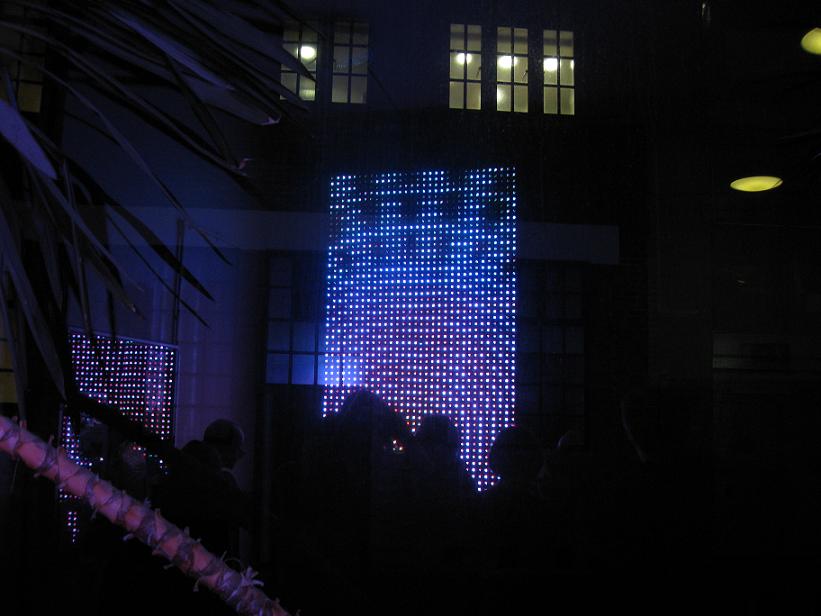
The Blip Prize is the latest stage in the IMCC’s development of exciting content for the extraordinary state-of-the-art wall-hanging LED installation that is our contribution to The International Distributed Display Initiative, and which is part of the Institute’s New Media Theory research project, coordinated by Peter Cornwell at Blip with Alison Craighead and David Cunningham at the IMCC. Using an interface that has been designed such that no prior programming skills are assumed, staff and students will be making work for this experimental new media laboratory that will allow them to explore in hands-on fashion what it means to translate, phenomenalize, or even perform media-theoretical issues as, and in, new media.
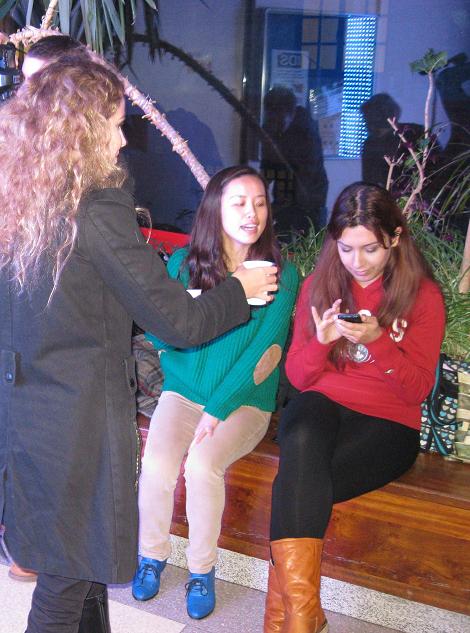
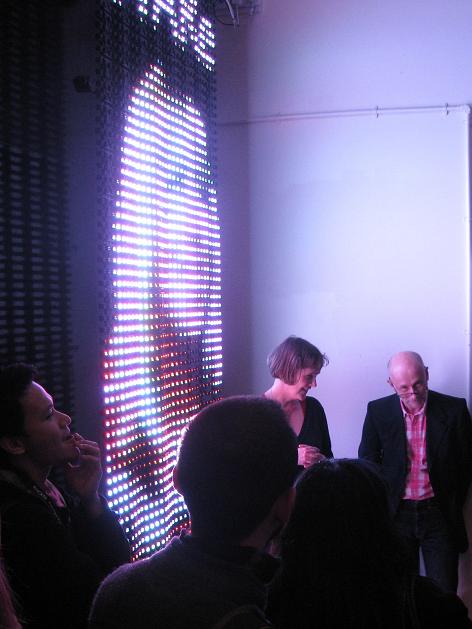
Watch this space!
UPDATE: Video of the awards ceremony courtesy of David Itzcovitz:
Fictions of the Not Yet
Tagged as Literature, novel, science fiction, The Future, time

Wednesday 9 November, 1.15pm – 2.30pm
Room 359, 309 Regent Street, University of Westminster
Caroline Edwards (University of Lincoln)
‘Fictions of the Not Yet’
As the first decade of the twenty-first century comes to a close, there is a growing critical awareness of the current fascination with alternative and future worlds in contemporary British fiction. In addition to the continuing popularity of – and growing scholarly interest in – speculative and genre works, an emerging body of “literary” fictions is revealing a wide-ranging preoccupation with narratives of apocalypse, transmigration and haunting. Writers like David Mitchell, Jeanette Winterson, Jim Crace, John Burnside, Marina Warner, Maggie Gee, Jon McGregor and Sam Taylor are thus shifting the parameters of realist literary fiction and its generic borrowings, and in the process articulating a shared concern with the question of temporality. We need to develop a new strategy of reading such fictions in order to examine the formal innovations executed by these visions of temporal alterity and futurity. This paper will outline a refunctioning of Ernst Bloch’s category of the “Not Yet” (Noch Nicht) in order to provide a methodological framework that can draw out the distinctly utopian implications that are prevalent in the contemporary British novel. This refunctioning not only reconsiders the relationship between philosophical discourse and narrative imaginaries, but also helps us outline the distinctive structural, thematic and stylistic characteristics shaping an emerging caucus of fictions.
Ranciere review
Tagged as Literature, radical philosophy, Theory

David Cunningham’s review of Jacques Ranciere’s The Politics of Literature, published in the latest issue of Radical Philosophy, is currently up as a freebie on the website. You can read it here: http://www.radicalphilosophy.com/uncategorized/flaubert%e2%80%99s-parrot

ADVENTURES IN NIGHTLIFE: PAUL KHERA
Thursday 3 November 2011, 19.00 – 23.00
AMBIKA P3
EXHIBITION-FILM SCREENING-MUSIC
Presenting the work of Paul Khera in an evening of film, music and photography on the theme of London nightlife.
EXHIBITION
One off prints featuring intimate moments of London nightlife
FILM SCREENING – 8.00 pm
‘Being Continued’, 37mins
Part film-noir, part meditation, a cinematic discourse on the journey of wisdom, there’s greed, violence, kidnapping; love, tranquility and revelation. This is a film that follows the cycle of human comprehension, gathering knowledge, being perplexed by it, testing wisdom with experience, suffering at the hands of greed, expanding and condensing knowledge, and finding peace. The story is part of the folklore of the himalya, it can be applied to society as a whole, or in the case of this film to an individual.
MUSIC:
Late Night tunes by Maxology
Paul Khera has worked across the full spectrum of the visual arts. He started his career taking stills at Channel 4, playing in a band, and designing sleeves for another. Through a chance meeting at college, he started working for the ICA in London, designing posters and catalogues, for amongst others Jake & Dinos Chapman, Lawrence Weiner, William Wegman and Damien Hirst. After the Arts came fashion, a short stint at Elle, and then Vogue. Following that was a period at corporate design heavyweights Ideo, on large-scale projects for P&G in Geneve and Vodaphone in Lisbon. Interspersed were a few projects for the British Council, which took him from Tokyo (an interactive project, describing Britain to the Japanese) to Damascus to Kano (an attempt to foster Muslim Christian tolerance through typography). Lately the projects have mainly been self-motivated, he designed a Hospital in rural India, using only local know-how and vernacular and is currently working on a six year scheme, a hand built retreat in the Himalayas; in which he designed everything from the building to the interior and the furniture… in the meantime he found time to write a book on philosophy and folklore, and a suite of music to go with it. Khera has also been commissioned to follow around the rock band Suede for a year, taking photographs at various gigs from the 100 club to the Royal Albert Hall documenting their return to fame, as well as build up a riveting portfolio of portraits from the nightlife of London.
AMBIKA P3, 35 Marylebone Road, London NW1 5LS
Entrance free.
http://www.p3exhibitions.com/
http://www.paulkhera.com/
For the latest video from the Institute’s AHRC Research Fellow Joe Banks, please go to:
Neurogenesis by Disinformation + Usurp (Signature Version)
Copyright © Joe Banks & Poulomi Desai 24 Oct 2011
http://www.wikipedia.org/wiki/Neurogenesis
http://en.wikipedia.org/wiki/Ivan_Chtcheglov
Contributions to forthcoming open issues include:
Emmanuel Alloa on Visual Studies in Byzantium, David Cunningham on the Metropolis; Willem Flusser on the gesture of photographing, Tom Holert on Bildwissenschaft, Esther Leslie on liquid crystals, Lev Manovich on visualization, Lynda Nead on boxing, Jacques Ranciere on cinema, Nicole Starosielski on transoceanic cables, Janet Wolff on the power of images, Winnie Wong on appropriation in Chinese visual culture.
Forthcoming themed issues include:
In 2012
Ways of Seeing: 40 Years On, with contributors including: Mieke Bal, Jon Bird, Lisa Cartwright, Jill H. Casid, Hazel Clark, Laurie-Beth Clark, Mike Dibb, Jennifer Gonzalez, Dick Hebdige, Richard Hollis, Elizabeth Guffey, S. Heller, Ben Highmore, Martin Jay, Guy Julier, Louis Kaplan, Peter Lunenfeld, Tara McPherson, Marita Sturken, Griselda Pollock, Adrian Rifkin, Vanessa Schwartz, and Ming Wong.
In 2013:
The Archives R Us issue, with contributors including: Raiford Guins, Gary Hall, Chris Horrocks, Tom Holert, Juliette Kristenesen, susan pui san lok, Joanne Morra, Hans-Ulrich Obrist, Vivian Rehberg, Marquard Smith, and Nina Lager Vestberg
Brixton Calling! exhibition
Tagged as archive, art, London

Brixton Calling!
28 October-21 December 2011, weekdays 10am-5pm
198 Contemporary Arts & Learning, Brixton
This exhibition is the final stage of Brixton Calling! archiving and community project that connects contemporary Brixton to its past through the history of the late Brixton Art Gallery & Artists Collective in the 1980s. Exhibition opening: Thursday 27 October 2011, 6.30-10pm.
UPDATE: Further details on the 198 website here: http://198.org.uk/pages/currentexhibition.htm
Brixton Calling! events at 198
Saturday 19 November, 2-4pm, Curators/artists talk
Friday 25 November, 7-9pm, Brixton Fairy Night
Saturday 26 November, 1-5pm, Radical Printing
Saturday 10 December, 2-5pm, Black Art
Other Brixton Calling! events:
’80s Women Lens Based Media Event
Brixton Village, Thursday10 & Friday11 November, 7-12pm, Saturday12 November, 10am–9pm
For more information contact: info@198.org.uk
Women Artists Feminism in the 80s and Now
Goldsmiths, University of London 3rd December, 10am-5pm, in collaboration with the Women’s Art Library
For more information contact: a.greenan@gold.ac.uk
Archive installation by Stefan Szczelkun and Oral History documentary on show continuously along with many other sub-projects!
Modern in Miniature
Tagged as Architecture, Modernism

For anyone interested in architectural models, design education, and photography, the Institute’s Dr Davide Deriu, a colleague from the Department of Architecture here at University of Westminster, has curated a fascinating exhibition entitled ‘Modernism in Miniature’ at The Canadian Centre for Architecture. If you happen to be in Montreal, why not swing by, it’s on until January 2012:
http://www.cca.qc.ca/en/exhibitions/1487-modernism-in-miniature
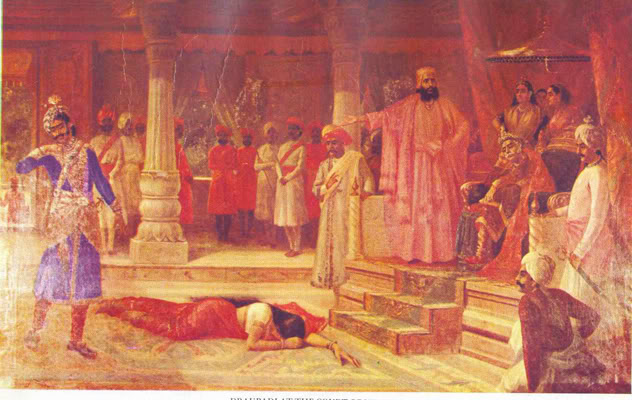
Our friends in the India Media Centre at University of Westminster are organizing a series of fascinating events, please see details below:
Thursday 13th October, 6.30pm
BHOPALI, a film
Bhopali, (dir. Max Carlson, 2011, 89 mins) is a multi-award-winning documentary about the survivors of the world’s worst industrial disaster, the 1984 Union Carbide gas leak in Bhopal, India. After the screening Mick Brown (journalist, writer and broadcaster) will chair a panel discussion with filmmaker Pawas Bisht (University of Loughborough), author, Meaghan Delahunt, (University of St Andrews) and Tim Edwards (International Campaign for Justice in Bhopal).
Venue: The Old Cinema, University of Westminster, 309 Regent Street, London W1B 2UW
Friday 14th October, 6.30pm
FORGOTTEN ERA: PARSI THEATRE AND EARLY INDIAN CINEMA
Kathryn Hansen, (University of Texas at Austin), a cultural historian with a special interest in Indian theatre, will present material from her new book Stages of Life: Indian Theatre Autobiographies (Anthem Press). This will be followed by a round-table discussion with Francesca Orsini, Reader in the Literatures of North India, SOAS; Rosie Thomas, Reader in Film and Director of CREAM and Co-director of India Media Centre at the University of Westminster; and Ravi Vasudevan, Professor of Film, Director of the Sarai Centre, Delhi, and Smuts Fellow at University of Cambridge.
Venue: Fyvie Hall, University of Westminster, 309 Regent Street, London W1B 2UW
Monday 17th October, 6.30pm
THE MAKING OF A MODERN INDIAN ARTIST-CRAFTSMAN: DEVI PRASAD
Devi Prasad was India’s pioneering artist-potter, visionary educationist and pacifist. This event looks at how his story exemplifies the importance of the Arts and Crafts Movement in shaping the nature of Modernism in India, and the role of pottery and the community of potters that Prasad set up. Naman P. Ahuja, (Jawaharlal Nehru University, New Delhi), will speak about the themes of his new book, The Making of a Modern Indian Artist-Craftsman: Devi Prasad, followed by a conversation with architect Sunand Prasad, Devi Prasad’s son, and with potter and writer, Julian Stair, Visiting Lecturer in Ceramics at the University of Westminster.
Venue: The Boardroom, University of Westminster, 309 Regent Street, London W1B 2UW
Friday 2nd November, 5pm – 9pm
INDIAN ARTS ON FILM: Charles Correa, Bhupen Kakar, Nalini Malani and Vivan Sundaram
What makes a successful documentary about art? What specific issues arise when translating the visual arts onto film? How far do different cultural contexts require different approaches? Award-winning arts filmmakers and scholars, Arun Khopkar and John Wyver (Iluuminations and University of Westminster), together with art historian Partha Mitter (University of Sussex), discuss these questions, followed by a screening of two of Khopkar’s films: Figures of Thought (1990, 33 mins), on Bhupen Kakar, Nalini Malani and Vivan Sundaram, and Volume Zero: The Work of Charles Correa (2008, 59 mins) on India’s most eminent architect.
Venue: P3 Gallery (5pm) and Cayley Lecture Theatre (7pm), University of Westminster, 35 Marylebone Road, London NW1 5LS
These events have been organised in association with our partners, DSC-South Asia Literature Festival and Magic Lantern Persistence Resistance Festival. As spaces are limited, BOOKING IS ESSENTIAL (follow web-links for each event). For full details visit http://www.westminster.ac.uk/schools/media/cream

Wednesday 10th October 2011, 1.15-2.30pm
Room 106, University of Westminster, 32-38 Wells Street, London W1T 3UW
Helen Glew (History, University of Westminster)
“Women at the Regent Street Polytechnic, 1882 – 1945”
Further details on the English Literature and Culture research seminar series here.
Metropolis Portuguese translation
Tagged as radical philosophy, Urban

David Cunningham’s 2005 essay ‘The Concept of Metropolis: Philosophy and Urban Form’, originally published in Radical Philosophy, has been translated into Portuguese by Luciana Rocha for the Brazilian journal Revista Periferia.
Any Portuguese readers can see it here: http://www.febf.uerj.br/periferia/index.html
Early warning: Joe Banks’ next Rorschach Audio lecture, Dec 7th
Tagged as art, sound art, technology, Theory
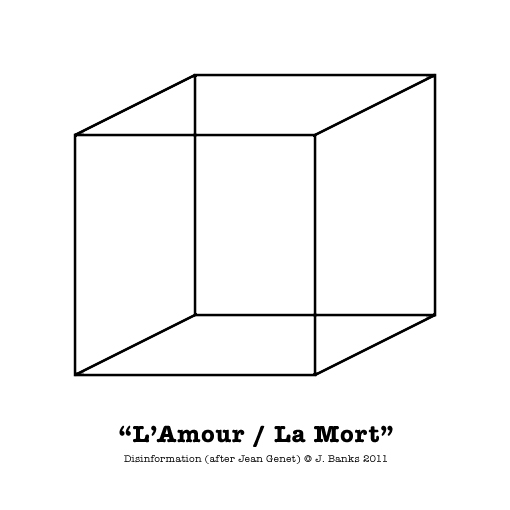
‘Rorschach Audio: Mysterious-devil-tale, Devil-bewitched-by-Death’
Wednesday 7 December 2011, 1.15pm – 2.45pm
Room 359, University of Westminster, 309 Regent Street, London W1B
Following on from the “Rorschach Audio” lecture demonstration presented to the IMCC in March 2011, and, in particular, that lecture’s discussions of Jean Cocteau, Salvador Dali, EH Gombrich, Primo Levi and Leonardo da Vinci, visual and sound artist Joe Banks presents further explorations of the influence of “Rorschach Audio” phenomena on contemporary literature and creative art. This presentation directly extends the material discussed in the previous lecture, so any guests not familiar with the earlier talk are encouraged to read the “Rorschach Audio” research publications available here…
http://muse.jhu.edu/journals/lmj/summary/v011/11.1banks.html
http://www.slashseconds.org/issues/002/004/articles/jbanks/index.php
Michael Nath’s first novel La Rochelle was shortlisted for the 2011 James Tait Black Memorial Prize for Fiction. At the award ceremony held at the Edinburgh Book Festival, chair of the judges Lee Spinks outlined his appreciation book in conversation with Sally Magnusson.

Money, Time, Representation: Literary Explorations (CFP)
In his Philosophy of Money, Georg Simmel notes that “we invest economic objects with a quantity of value as if it were an inherent quality” but “the question as to what value really is, like the question as to what being is, is unanswerable”. The element of unaccountability in money can also be seen in Marx, although he articulated the nature of money quite differently as an expression of social relations. Literature has always been very sensitive to the contingent, hence fictional, aspect of money.
A proposed session is planned on the topic for the IAPL (International Association for Philosophy and Literature) 2012 conference Archaeologies of the Future: tracing memories/imaging spaces to be held in Tallinn, Estonia next spring. We are looking for papers where the nature of money is explored in literature, and papers that ask how and if money in literature is the same as money in philosophy. The issues can include, but are not limited to, the nature of money as representation of value, or as representation of authority, or the role of money as an expression of a temporal pact that affects our sense of time. If you are interested in the topics of money in literature and/or money in philosophy, or parallels between writing and money, please send in your abstract ASAP (max. 1000 words) to the email address below. The session can include four to five speakers. Please note that all speakers must be IAPL members by the end of September 2011. For more details, see: www.iapl.info
Dr Tiina Käkelä-Puumala, University of Helsinki, Finland
email: tkakela@mappi.helsinki.fi


The Institute for Modern and Contemporary Culture
University of Westminster Department of English, Linguistics and Cultural Studies
32-38 Wells Street, London W1T 3UW. United Kingdom.