-
Architecture
archive
art
Ballard
body
China
cinema
ecology
education
Europe
Ezra Pound
futurology
gothic
image
law
Literature
London
magic
memory
Modern
Modernism
museums
music
novel
performance
photography
poetry
politics
radical philosophy
science
science fiction
Sinclair
Situationism
sound art
Surrealism
technology
television
the avant-garde
The Future
Theory
thomson
time
Urban
visual culture
war
Posts tagged art
Stefan Szczelkun’s Agit Disco has been widely and very positively reviewed in a number of recent publications. The project collects the playlists of its 23 writers to tell the story of how music has politically influenced and inspired them. The book provides a multi-genre survey of political musics that goes beyond protest songs into the darker hinterlands of musical meaning.
In Anarchist Studies 20.2, Jim Donaghey describes Agit Disco as ‘highly effective in sparking a reconsideration of the reader’s or listener’s experience of music and politics’, in a way which ‘will surely encourage others to begin their own dialogues, and contribute to those million compilation CDs that Szczelkun hopes for’, while Phil England, in The Wire, remarks that the ‘personal selections inside, directly or indirectly, prompt all kinds of questions, reanimating them as a living dialogue in the present.
In a lengthy review in the journal Socialism and Democracy, Matt Callahan is particularly insightful: ‘The music industry long ago made pop music journalism an extension of its dominance over music production, distribution and consumption. Agit Disco has the great virtue of enabling informed discussion of music by people who clearly cherish the music they are discussing. The value of music, therefore, is of a different order of magnitude than that of a disposable unit manufactured for financial gain. What comes across is a love and respect for music, a celebration of music’s timeless role in the life of communities and in their resistance to oppression … The task Agit Disco sets out to accomplish, therefore, bears a superficial resemblance to both cultural studies and pop music journalism while on a more profound level making a critique of both. That this critique comes in the form of a praxis as opposed to a conventional polemic is actually part of the critique – targeting self-proclaimed or institutionally sanctioned “experts” who in addition to passing judgement on what is good music and its proper relationship with politics, rule out the intelligence and creativity of working-class and other supposedly less qualified people’.
There is also an interview with Stefan Szczelkun and Anthony Iles published in BANTmag (Turkey): http://www.bantmag.com/mag/04/page/view/448
Agit Disco is published by Mute books, 46 lexington st, london, w1f 0lp. www.metamute.org
Alexa Wright at Digital Aesthetic, Oct 5-6
Tagged as art, technology, visual culture

Alexa Wright is taking part in Digital Aesthetic³ 2012, an international exhibition and conference which explores the impact that the digital has on our sense of self and our relationship to the physical world. The exhibition is housed in the Harris Museum & Art Gallery, and the University of Central Lancashire’s PR1 Gallery in Preston. It demonstrates some of the diverse ways that artists are utilising digital technology, including projection, digital print, 3d work, screen based video work, touch panel installation, and a live interactive website. The conference takes place over Friday Oct 5th and Saturday Oct 6th. In a great line up, other participants include Mark Amerika, Sean Cubitt and Sophie Calle.
Further details at: http://digitalaesthetic.org.uk/

We’re excited to announce that Thomson and Craighead been shortlisted for this year’s Jarman Award amid a fantastic group of artists. You can find more info on the shortlist here: http://flamin.filmlondon.org.uk/projects/projectscurrent/jarmanaward/jarman_award_12
In other news, Thomson and Craighead are premiering their series of karaoke videos as part of the Film & Video Umbrella exhibition, ‘Our Mutual Friends’ launching online and for an event at Jerwood Space, London on 30th August 2012. The videos take a fresh look at unsolicited spam emails and their affinities with notions of romanticism and realism. You can view online versions of the videos here: http://www.youtube.com/user/songsofinnocence100
The duo have also been commissioned to make a new installation for this year’s Brighton Photo-biennial: a documentary artwork that looks at the burgeoning Occupy movement and its explosion worldwide during October 2011. The recent documentary artwork, ‘Belief’ is streaming online as a single screen work at Animate Projects alongside an interview and an essay by Morgan Quaintance. Finally, ‘The Time Machine in alphabetical order’ is showing as part of ‘Trans Adriatic Grey Area’ exhibition at LAMPO in Italy. The exhibition is curated by Darko Fritz for Lampo Net & Contemporary art Exhibition, D’Annunzio Room, Aurum, Pescara from August 25th – September 24th 2012.
Open Call: Delfina Foundation, Videobrasil and Casa Tomada
Tagged as art, Brazil, cinema, visual culture
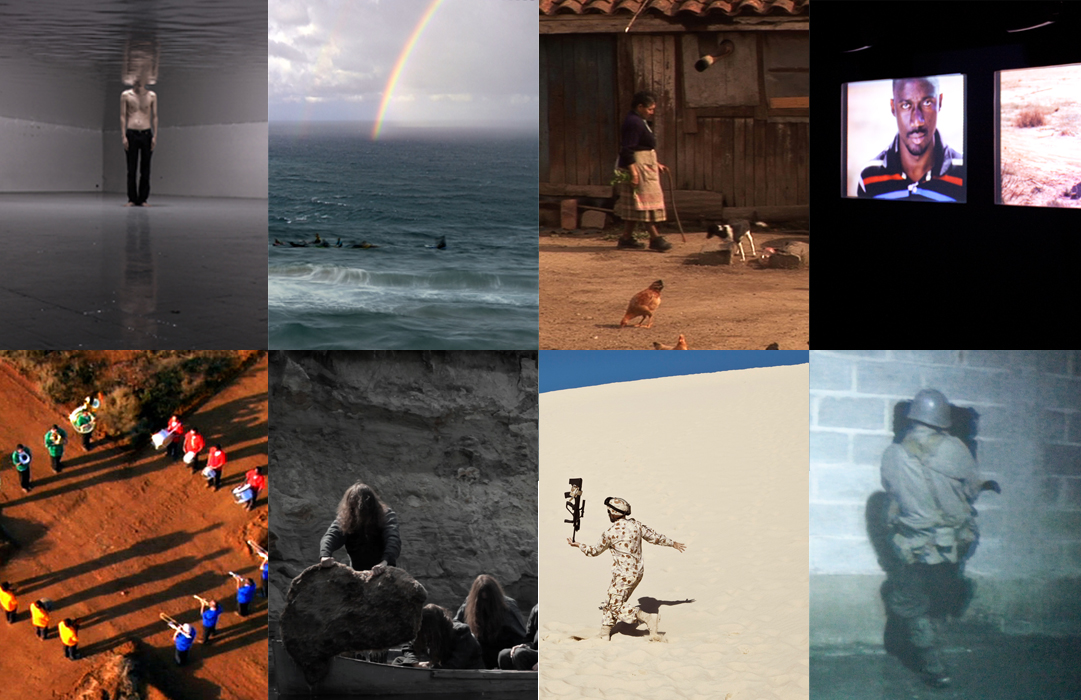
Our friends at the Associação Cultural Videobrasil in partnership with Delfina Foundation and Casa Tomada (São Paulo, Brazil) are pleased to invite applications from visual artists living and working in Brazil and the Middle East, North Africa & South Asia (MENASA) for a three-month artistic residency split between São Paulo and London. The Videobrasil em Contexto Prize (Videobrasil in Context) is focused on artists, under the age of 35, whose practice involves a strong element of research and production. Two artists (one from Brazil and another from MENASA) will be selected to undertake the three-month residencies from mid-September 2012 and produce a new works in response to Videobrasil’s Collection.
The Collection available for each artist are the works that have been part of the Southern Panoramas show each year since 1990, when Videobrasil focused on the geopolitical South. An overview of this 20+ year selection is available for the applicants at: www.videobrasil.org.br/vbonline During the residencies, various public platforms will be created for the artists in São Paulo and London. At the end of the residency, the artists will be asked to prepare a presentation of their projects to be part of the activities of the 30th Anniversary of the International Contemporary Art Festival SESC_Videobrasil in October 2013.
– Deadline for applications: 8th June 2012
– Artists shortlisted: June 15th, 2012
– Interviews with shortlisted artists through Skype: June 20th to July 22nd, 2012
– Announcement of Selection: 2nd July, 2012
– Program Length: September 17th – December 29th, 2012
[São Paulo: September 17th – October 29th, 2012; London: October 29th – December 17th, 2012]
For more information on the programme and selection process, please download an application form here in English.
Thomson & Craighead’s Belief
Tagged as art, thomson, visual culture

Thomson and Craighead are premiering their new documentary artwork, ‘Belief’ as part of the Edinburgh Film Festival. It’s the final work in the Flat Earth Trilogy following on from Flat Earth (2007) and A short film about War (2009/2010), and will be shown at Inspace, Edinburgh from 21st June – 1st July 2012. e-flyer: http://www.thomson-craighead.net/belief
In other news, Thomson and Craighead have donated a print for an Animate Projects fundraiser aiming to help keep the brilliant Animate Projects archive online. So if you fancy donating to the cause and walking away with an artists’ print, then do go along on Wednesday 13 June, 6.30-8.30pm, Berners House, 47-48 Berners Street, London. Email: tarnia@animateprojects.org for more information about this.
Finally, work by Thomason and Craighead is also appearing in two group shows: ‘Image Counter Image’ at the Haus der Kunst, Munich, 10th June 2012 – 16th September 2012; and ‘Gateways: Art & Networked Culture’, Haus für elektronische Künste, Basel, 2nd June 2012 – 19th August 2012.
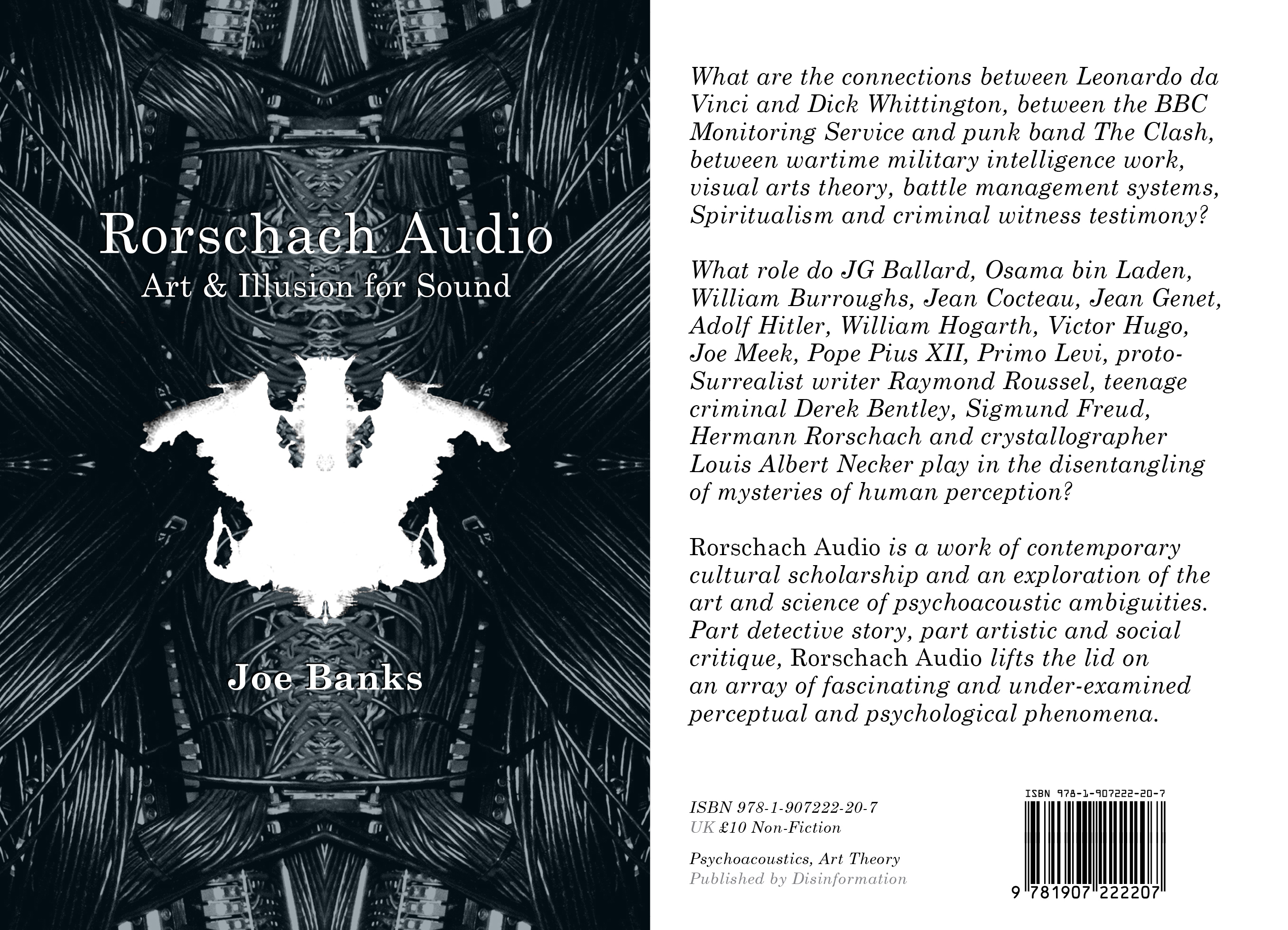
“Rorschach Audio – Art & Illusion for Sound” by Joe Banks – “The earliest form of sound recording technology was not a machine but was written language…” (page 96)
What are the connections between Leonardo da Vinci and Dick Whittington, between the BBC Monitoring Service and punk band The Clash, between wartime military intelligence work, visual arts theory, battle management systems, Spiritualism, radio and recording technology and criminal witness testimony? What role do JG Ballard, Osama bin Laden, William Burroughs, Jean Cocteau, Jean Genet, Adolf Hitler, William Hogarth, Victor Hugo, Joe Meek, Pope Pius XII, Primo Levi, proto-Surrealist writer Raymond Roussel, teenage criminal Derek Bentley, Sigmund Freud and crystallographer Louis Albert Necker play in the disentangling of mysteries of human perception?
“Rorschach Audio” is a work of contemporary cultural scholarship and an exploration of the art and science of psychoacoustic ambiguities. Part detective story, part artistic and cultural critique, “Rorschach Audio” lifts the lid on an array of fascinating and under-examined perceptual and political phenomena.
“Rorschach Audio” is essential reading for everyone interested in air-traffic control, anechoic chambers, artificial oxygen carriers, audio art, bell-ringing, cocktail parties, cognitive science, communications interference, compost, the death penalty, Electronic Voice Phenomena, evolutionary biology, experimental music, ghosts, the historiography of art, illusions of sound and illusions of language, lip-reading jokes, nuclear blast craters, predictive texting, singing hair, sonic archives, sound design, steam trains, tinnitus, the Turing Test, Victorian blood painting, visual depth and space perception, ultrasonic visual music, ventriloquism, voices and warehouse fires and robberies.
Trade distribution by Turnaround
Production by Strange Attractor
Published by Disinformation
ISBN 978-1-907222-20-7
Hardback, 191 pages
UK £10 Non-Fiction
Psychoacoustics, Art Theory
RELEASE DATE MONDAY 21st MAY 2012

A great article on the BBC website about Alexa Wright’s A View for Inside. Here’s a snippet: `A View From Inside’ is an exploration of some alternative perspectives on reality. Her thought provoking portraits offer a window into the unique realities experienced by Theresa and nine other people who have been affected by a psychotic `disorder’ such as bipolar or schizophrenia. Alexa Wright’s aim is two fold. “One is bringing issues of mental health into the public domain, she said. ‘But the other is to look at our notion of reality. What is reality, we all operate in society on the basis that what we consider real is the same as what someone else might. But it’s interesting to look at a reality that only one person is privy to but for them is absolutely real when they are experiencing it.’
Read the full article here: http://www.bbc.co.uk/news/health-17618459
Thursday 5 April 2012, 7pm
Whitechapel Gallery, 77-82 Whitechapel High Street, London E1
Price: £7.00 / £5.00 concessions (includes free glass of wine).
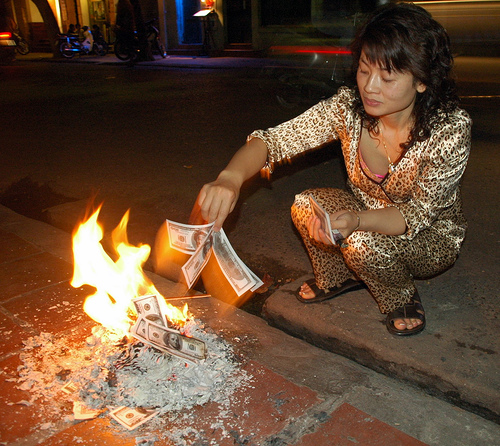
This season’s Whitechapel Salon organised by the IMCC in collaboration with the Whitechapel Gallery is on ‘Cultures of Capitalism’. The fifth salon turns to that social and economic form at the very heart of capitalist cultures: Money. In the light of contemporary crises in financial capitalism, Professor Peter Osborne, Director of the Centre for Modern European Philosophy at Kingston University, and author of books including The Politics of Time, Philosophy in Cultural Theory, and Conceptual Art, will be in discussion with David Cunningham about money, cultural form, and the nature of the ‘real’ today.
Book your ticket at:
http://www.whitechapelgallery.org/shop/index.php/fuseaction/shop.product/product_id/1160

We are delighted to announce the publication of Alexa Wright’s book A View From Inside from White-Card. Including essays from Graham Thornicroft and Jeanne Randolph, A View From Inside challenges our preconceptions about what constitutes reality. The ten portrait photos in the book draw on the principles of eighteenth-century portrait painting to give form to the unique realities encountered by different people during psychotic episodes.
The book is published to accompany a series of ten framed photographic portraits (76 x 100 cm / 30 x 40 inches) designed for gallery exhibition.
RRP £22.00
ISBN: 978-0-9571558-0-0
For more information visit: www.alexawright.com
Exhibiting Video – 23-25 March, University of Westminster
Tagged as art, cinema, technology, visual culture

The Institute’s friends and colleagues in the Centre for Research and Education in Arts and Media (CREAM) at University of Westminster are organizing a three-day international conference this coming weekend on ‘exhibiting video’, please see below for full details:
Exhibiting Video – International Conference
Date: 23, 24 and 25 March, 2012
Venue: University of Westminster, 309 Regent Street, London, W1B 2UW
To coincide with the new David Hall Ambika P3 commission ‘1001 TV Sets (End Piece)’ 1972-2012 the Centre for Research and Education in Arts and Media (CREAM) of the University of Westminster is convening Exhibiting Video, a three-day event considering issues central to the display of video art. Bringing together notable artists, curators and writers the event will provide a forum for a number of related questions:
· On what terms has the rise of video in contemporary arts taken place?
· How do notions of medium specificity and site specificity shape video art work made for exhibition?
· What is the legacy of analogue video technology in the digital age?
· How do our museums and galleries understand video art?
Confirmed participants include:
Mark Bartlett, Irit Batsry, Amanda Beech, Steven Ball, Steven Bode, Margarida Brito Alves, David Campany, Stuart Comer, Sean Cubitt, Shezad Dawood, Catherine Elwes, Solange Oliveira Farkas, Terry Flaxton, David Hall, Adam Kossof, Anya Lewin, Adam Lockhart, Chris Meigh-Andrews, Stuart Moore, Marquard Smith, Kayla Parker, Margherita Sprio, Minou Norouzi, Stephen Partridge, Ken Wilder and Lori Zippay
To register please go to:
http://www.westminster.ac.uk/research/a-z/cream/events/exhibiting-video-conference
Thomson & Craighead are Being Social
Tagged as art, technology, thomson

Thomson & Craighead are part of the inaugural exhibition ‘Being Social’ in the new Furtherfield Gallery slap bang in the middle of Finsbury Park, North London where they are showing a version of ‘London Wall’. The exhibition is on already and runs until 28th April. Details here.
T&C are also showing a new projected version of ‘Flipped Clock’ and the short documentary artwork, ‘Several Interruptions’ as part of the exhibition ‘Mirror Neurons’ at the National Glass Centre in Sunderland, on until 20th May. Details here.
They’ve also completely revamped their 2001 online artwork ‘e-poltergeist’ for the Canadian journal ‘BleuOrange’, and this goes live on 20th March at 0300hrs GMT. And finally, a new artwork, ‘A live portrait of Sir Tim Berners Lee (an early warning system)’ will be part of the major new exhibition, ‘Life Online’ launching in the National Media Museum on 29th March. Further details here.
Cultures of Capitalism V: Money, Whitechapel Salon, April 5th
Tagged as art, money, politics, radical philosophy
Thursday 5 April 2012, 7pm
Whitechapel Gallery, 77-82 Whitechapel High Street, London E1
Price: £7.00 / £5.00 concessions (includes free glass of wine).
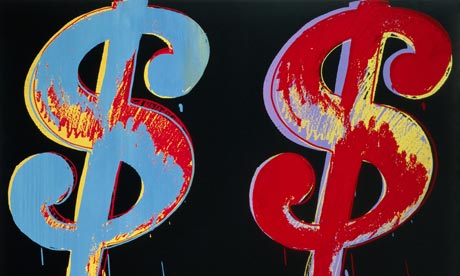
This season’s Whitechapel Salon organised by the IMCC in collaboration with the Whitechapel Gallery is on ‘Cultures of Capitalism’. The fifth salon turns to that social and economic form at the very heart of capitalist cultures: Money. In the light of contemporary crises in financial capitalism, Professor Peter Osborne, Director of the Centre for Modern European Philosophy at Kingston University, and author of books including The Politics of Time, Philosophy in Cultural Theory, and Conceptual Art, will be in discussion with David Cunningham about money, cultural form, and the nature of the ‘real’ today.
Book your ticket at:
http://www.whitechapelgallery.org/shop/index.php/fuseaction/shop.product/product_id/1160?
‘Now! Visual Culture’ at NYU, May 31-June 2, 2012, the second biennial conference of the International Association for Visual Culture
Tagged as art, visual culture

http://www.visualculturenow.org/itinerary/
“Now! Visual Culture” is a participation event, to be held at New York University, May 31-June 2 2012. The goal is to showcase as broad and diverse a range of visual culture practice as possible in order to create a snapshot of the field of visual culture as it is currently practiced from Cape Town to California.
At the 2010 Visual Culture Studies Conference in London, hosted by the Institute at University of Westminster, a decision was taken to constitute an International Association for Visual Culture. A key principle was that the Association should ask as little as possible financially from its members while involving as many people as possible in decision making. This is the first event organized under this platform. By the end of the event, delegates will have both experienced and created the transformation of the field from an interaction of cinema studies and art history (as it was in the 1990s) to the present intersection of Web 2.0, iconology, contemporary art practice, and critical visuality studies.
The event is structured so that all delegates will attend a single stream of sessions to create a strongly interactive conference experience. The event begins with 15×5 minute lightning talks on the state of the field by people ranging from postdocs to professor emeritus. There are eight sessions following, organized by people in a variety of locations, including the Visual and Cultural Studies Program at the University of Rochester, the Brooklyn Filmmakers Collective, the Alliance for Networking Visual Culture and the Diasporic Asian Art Research group. Each session will be independently organized in keeping with the horizontal ethics of the Association.
Particular time slots have a hands-on workshop, film screenings, panel discussions or a combination of the above.
Current session themes include:
a workshop with Scalar, a born-digital multi-media authoring platform
the role of design in globalization
new media coverage of the Occupy Wall Street movement
Asian diaspora art practices
practice in and as visual culture
a graduate student forum
the general assembly of the International Association for Visual Culture
keynote ‘listeners’ and talkback
Lots of time for networking and enjoying New York, with receptions every night, a gallery exhibition of online and material work, and maybe a late-night shenanigan or two!
‘Exhibiting Video’ conference, 23-25 March – Call for Papers extension
Tagged as art, cinema, visual culture

http://www.westminster.ac.uk/research/a-z/cream/events/exhibiting-video-conference
CALL FOR PAPERS – EXTENDED CALL
DEADLINE 15 February 2012
Exhibiting Video – International Conference
Date: 23 – 25 March, 2012
University of Westminster, 309 Regent Street, London, W1B 2UW
In March and April 2012 Ambika P3, the flagship exhibition space at the University of Westminster, will present a major solo exhibition of the influential pioneer of video art, David Hall in association with REWIND. To mark the occasion the Centre for Research and Education in Arts and Media (CREAM) of the University of Westminster is convening Exhibiting Video, a three-day event considering issues central to the display of video art.
We welcome proposals for papers of a maximum of 30 minutes. Send abstracts of no more than 250 words. They must include the presenter’s name, affiliation, email and postal address, together with the title of the paper and a 150-word biographical note on the presenter. Abstracts should be sent to Helen Cohen at photography@westminster.ac.uk and arrive no later than Wednesday 15 February 2012.
Exhibition at 309 Regent Street: AV London & Through the Lens
Tagged as art, London, photography, Urban
AV London
Through the Lens: Embodying the City
12th December 2011 to 12th January
309 Regent Street Gallery, University of Westminster, London W1B 2UW
A very successful opening party for two exhibitions, ‘AV London’ and ‘Through the Lens: Embodying the City’, curated by students on our Masters programmes in Cultural and Critical Studies, Museums, Galleries & Contemporary Culture, and Visual Culture. Thanks to Kristian Agustin for the photos. Both shows are on until January 12th at 309 Regent Street, so do go and check them out.
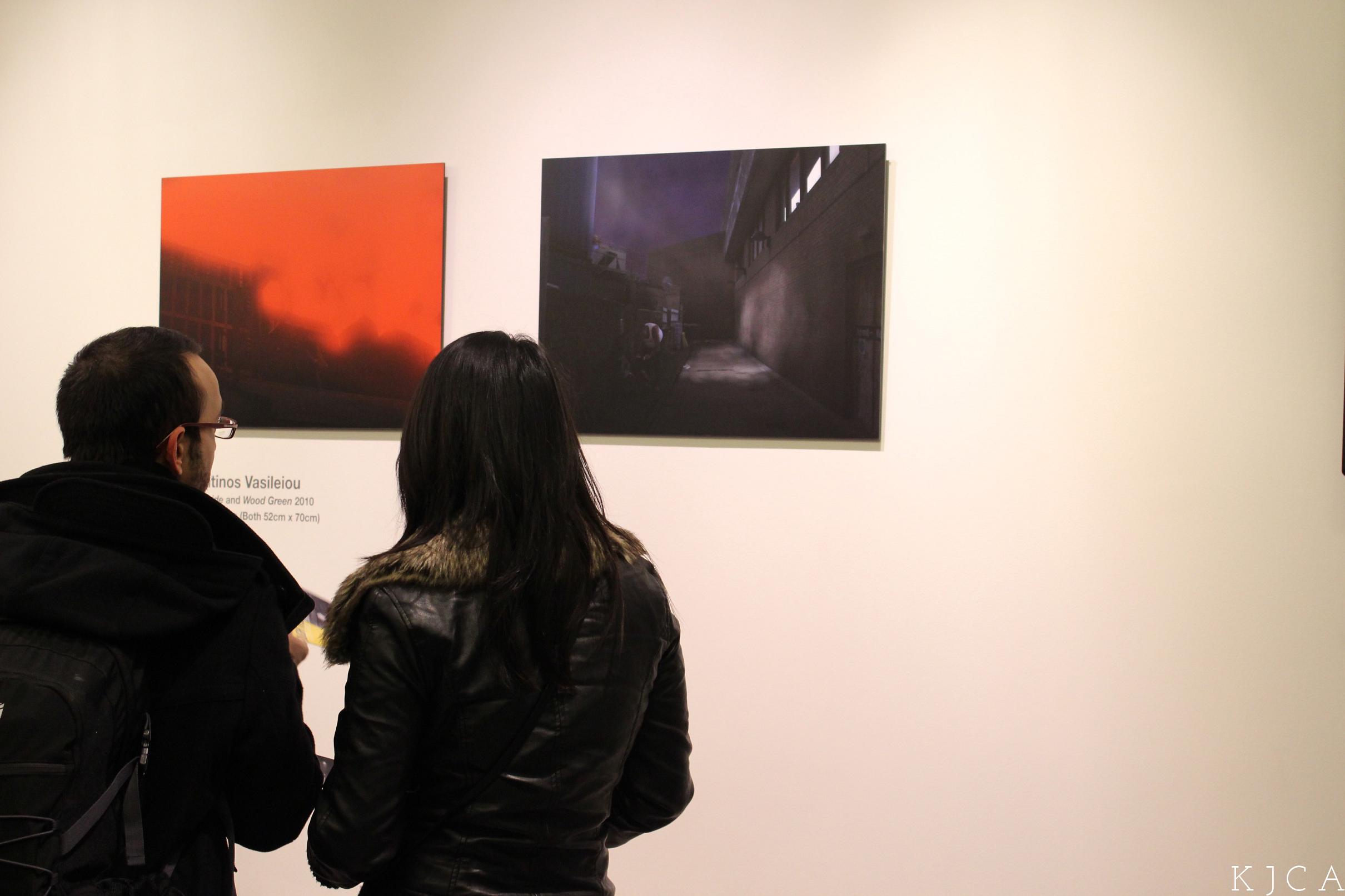
‘Through the Lens’ explores the relationship between the body and the urban environment. The collection of photographs explores the contrasts of corporeal dynamism and the solid urban canvas. The exhibition features contributions from four London based artists who each have an individual interpretation of the relationship between the people and the city: Michael Frank, Christina Lange, Peter Tweedie and Konstantinos Vasileiou. Further details on the exhibition website at: http://embodyingthecity.blogspot.com/
Curated by Eleni Tziourtzia, Angelica Sada, Xiaosong Liu, Ciara Fitzpatrick (curatorial); Alice Gibbs, Elena Griva, Katrina Macapagal (texts); Fliss Hooton, Nadia Little (production); Kristian Jeff Agustin, Alessandra Ferrini (design).
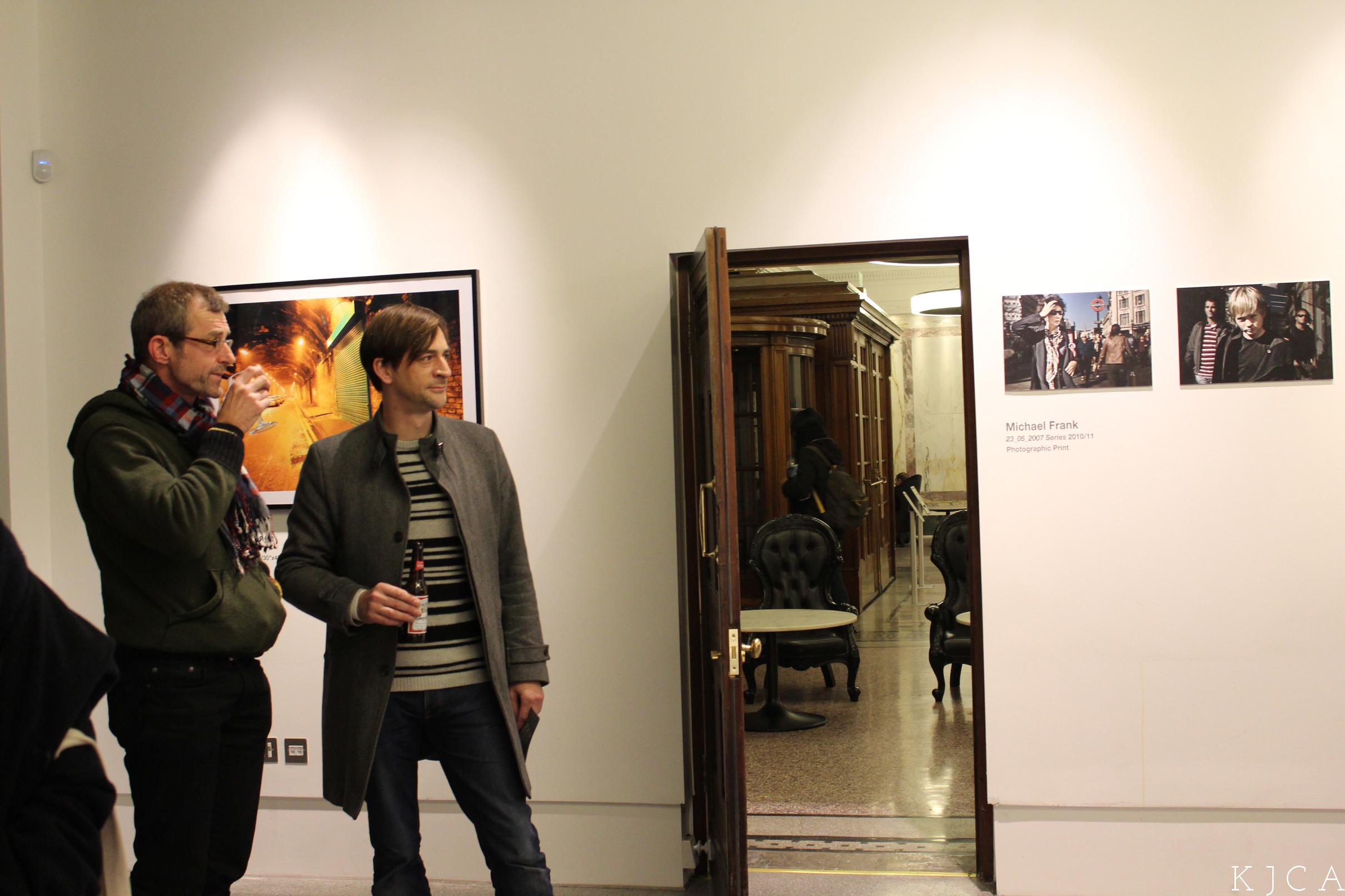
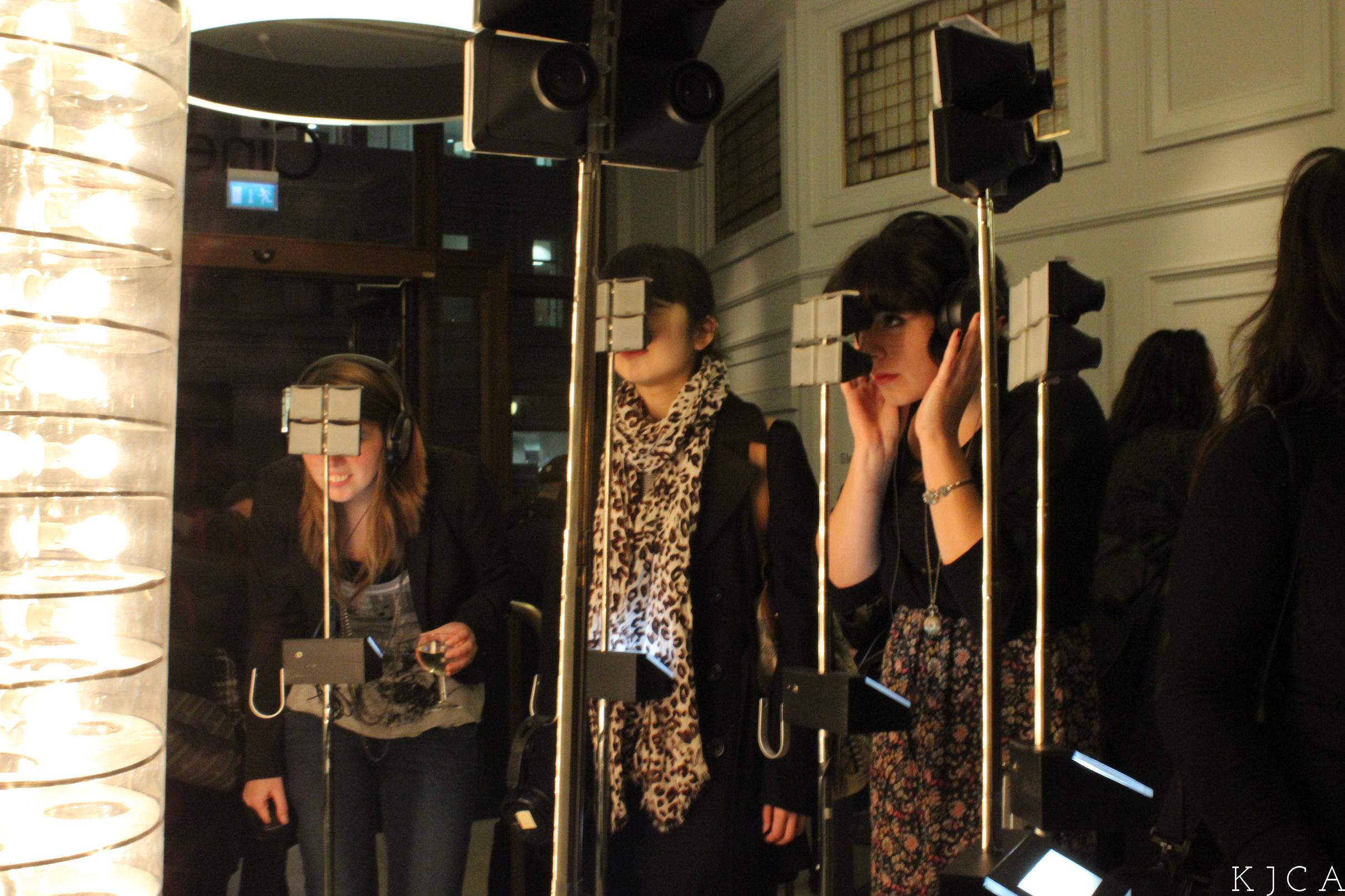
‘AV London’ is an exhibition of Stereoscopic (3D Photography) and Binaural recordings made the artist Gary Welch, which capture a cornucopia of sights, sounds and voices of the diverse metropolis of London. Welch’s installations transform the basic viewer into viewer-listener, who then becomes the ears and eyes of the ‘anyperson’ interacting with seven unique moments in London.
Curated by Elisa Adami, Miguel Corte Real, Leonardo Couto, Nihan Gumrukcuoglu, Silvia Morena, Menming Ran, Z Amber Richter, Kalliopi Tsipini-Kolaza, Simone van Eijk, Laura Vichick.
Modernism, a Sentimental Myth
Tagged as Architecture, art, Modern, Modernism

This Saturday 10th December, our Visiting Fellow, Victoria Walsh, will be taking part in a panel discussion for Modernism, a Sentimental Myth, part of the Bloomberg New Contemporaries 2011 at the ICA. Other panellists include our former colleague, and member of the IMCC Advisory Board, Murray Fraser.
The panel is at 5pm, preceded by a walking tour around the back streets of the ICA, and followed by a Club Night. For more details visit www.ica.org.uk
Rorschach Audio talk, Wednesday 7 December 2011
Tagged as art, sound art, technology
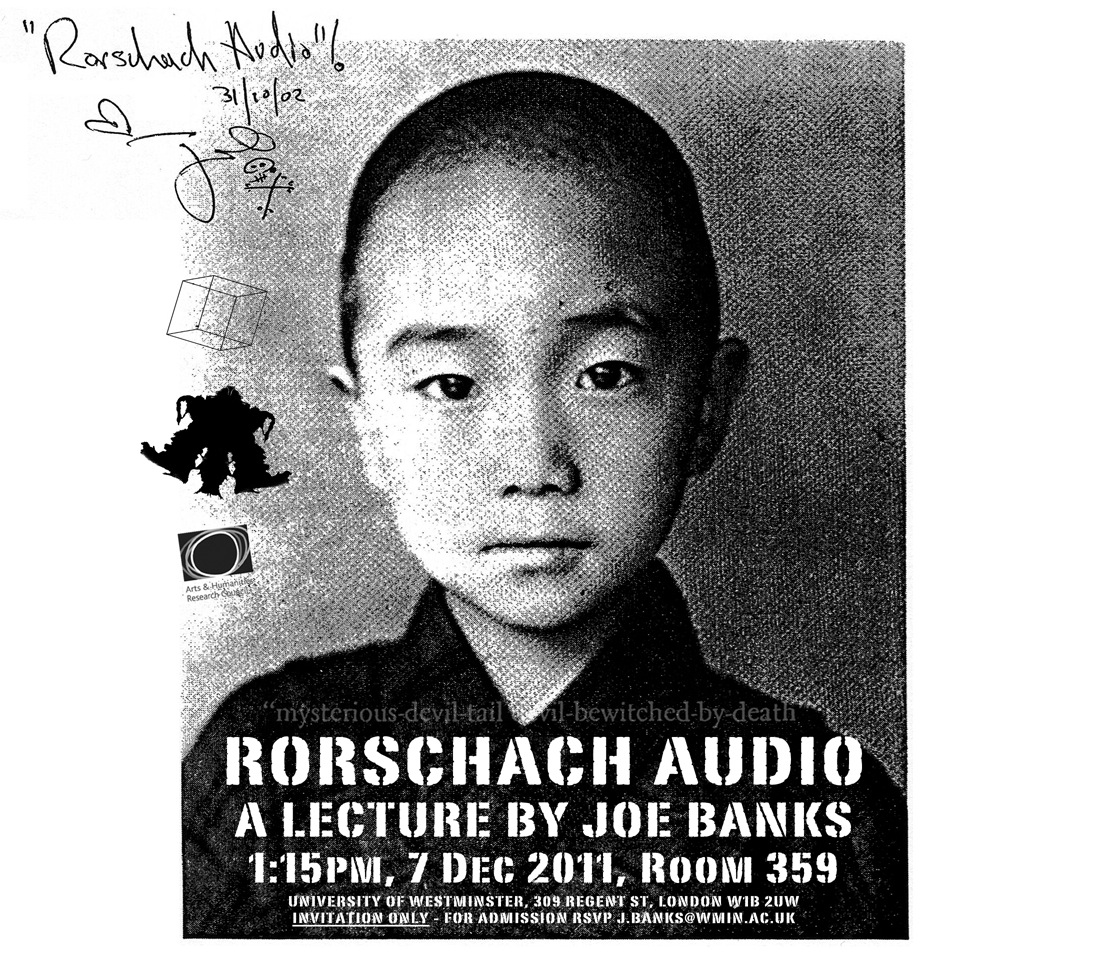
‘Rorschach Audio: Mysterious-devil-tale, Devil-bewitched-by-Death’
Wednesday 7 December 2011, 1.15pm – 2.45pm
Room 359, University of Westminster, 309 Regent Street, London W1B 2UW
Following on from the “Rorschach Audio” lecture demonstration presented to the IMCC in March 2011, and, in particular, that lecture’s discussions of Jean Cocteau, Salvador Dali, EH Gombrich, Primo Levi and Leonardo da Vinci, visual and sound artist Joe Banks presents further explorations of the influence of “Rorschach Audio” phenomena on contemporary literature and creative art. This presentation directly extends the material discussed in the previous lecture, so any guests not familiar with the earlier talk are encouraged to read the “Rorschach Audio” research publications available here…
http://muse.jhu.edu/journals/lmj/summary/v011/11.1banks.html
http://www.slashseconds.org/issues/002/004/articles/jbanks/index.php
Non-Westminster staff and students should RSVP Joe Banks at: j.banks@wmin.ac.uk
Tuesday 22nd November, 4-6pm
Westminster Forum, University of Westminster, 32-38 Wells Street, London W1T
Pascal Gielen (Groningen University, The Netherlands)
‘Mapping the Community Arts: Artistic Autonomy, Repressive Tolerance and Pastoral Power’
In recent years there has been increased attention to so-called ‘socially engaged art practices’. Equipped with a sense of urgency and intent, artists and curators develop work with the support of communities or groups to tackle political and social issues. While the success of these projects are not easily measurable, they often reiterate the role of artist/curator as protagonists of specific forms of social change, which posits a direct contrast to recent activism which carefully distances itself from any leader-based political organizational categories.
Pascal Gielen, co-editor of the recently published volume Community Art, will draw out a critical cartography of community art and will speak about the power and impotencies of this phenomenon. Since modernity, art and community, artist and social work have had an ambivalent relationship, can art have a role in building communities? What is the political potency of forms of art that strive to integrate individuals and social groups? Pascal Gielen is Professor of Sociology of the Arts and Director of the research centre Arts in Society at Groningen University. His publications include The Murmuring of the Artistic Multitude: Global Art, Memory and Post-Fordism (Valiz, 2009) and the co-edited Being an Artist in Post-Fordist Times (NAi Publishers, 2009).
Back in July, IMCC Visiting Fellow Dr Young-Paik Chun from Hongik University in Seoul programmed an event on Korean contemporary art on British soil at London’s Korean Cultural Centre. Details here.
Following the event, a report entitled ‘Situating Korean Fine Art Practice in a Western Context’ written by Dr John Cussans came to our attention. It is attached here, many thanks to John for making it available, and our apologies for the delay in posting it:

Thursday 8 December 2011, 7pm
Whitechapel Gallery, 77-82 Whitechapel High Street, London E1
Price: £7.00 / £5.00 concessions (includes free glass of wine).
This season’s Whitechapel Salon organised by the IMCC in collaboration with the Whitechapel Gallery is on ‘Cultures of Capitalism’. Our third discussion focuses on imagining the Spaces of Capital. How can art and politics image, represent or map the spaces of contemporary capitalism? And, in the light of current spaces of occupation, what critical and political possibilities for resistance or opposition might such imaginings contain? Participants include Alberto Toscano, Senior Lecturer in Sociology at Goldsmiths and author of The Idea of Fanaticism, and Andy Merrifield, author of Metromarxism and Dialectical Urbanism, along with a representative from the Haircut Before the Party collective. Chaired by David Cunningham.
Book your ticket at: http://www.whitechapelgallery.org/shop/product/category_id/22/product_id/1027?session_id=1320678264848dfa9cc85be835a3493e662f207489


The Institute for Modern and Contemporary Culture
University of Westminster Department of English, Linguistics and Cultural Studies
32-38 Wells Street, London W1T 3UW. United Kingdom.