-
Architecture
archive
art
Ballard
body
China
cinema
ecology
education
Europe
Ezra Pound
futurology
gothic
image
law
Literature
London
magic
memory
Modern
Modernism
museums
music
novel
performance
photography
poetry
politics
radical philosophy
science
science fiction
Sinclair
Situationism
sound art
Surrealism
technology
television
the avant-garde
The Future
Theory
thomson
time
Urban
visual culture
war
Posts tagged technology
CSD Accelerationism Workshop, May 23rd
Tagged as radical philosophy, technology, The Future

From our friends in the Centre for the Study of Democracy:
Accelerationism: A Workshop
May 23rd 2014, 11.00-4.30 (Closed Workshop), 6-8 (Open Plenary)
University of Westminster, 309 Regent Street, London
The Centre for the Study of Democracy invite you to a workshop on the emerging theme of ‘accelerationism’ – an attempt to recuperate the liberating potential of reason, technology, and modernity. In the wake of ongoing economic, environmental, and social crises, accelerationism argues that the proper response requires unleashing these potentials from their current strictures, and avoiding tendencies towards localism, primitivism, and romanticism. Accelerationism seeks to name a general disposition already underway in disparate fields such as politics, philosophy, science, engineering, and design.
This workshop aims to open and extend a discussion on accelerationism: bringing together the supportive, the sceptical and the curious to debate the philosophical underpinnings and political implications of the concept as well as ‘actually existing accelerationisms’. Speakers include: Benjamin Noys, Patricia Reed, David Cunningham, Helen Hester, Benedict Singleton, Richard Barbrook, Ben Woodard.
This will be followed by an open plenary in The Boardroom at Regent Street entitled: ‘Occupy the Future: Is a Promethean Politics Possible?’, with Nick Srnicek & Alex Williams (authors of Manifesto for an Accelerationist Politics), Rachel Armstrong and Craig Gent (Plan C).
Martin Willis Professorial Lecture: Imagination & the Sciences, March 26
Tagged as Literature, science, technology
Wednesday 26th March 2014, 6pm
Fyvie Hall, University of Westminster, 309 Regent Street, London W1B 2HW
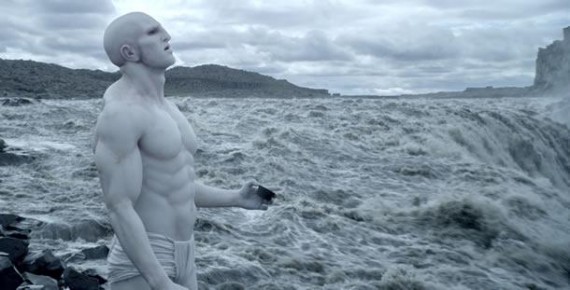
“Imagination and the Sciences, or, Why Frankenstein May Still Be the Modern Prometheus”
Professor Martin Willis (University of Westminster)
Two distinct but related themes have emerged in recent discussions of the relationship between the sciences and the humanities. First, there has been a sustained rejection in academic communities of the perceived dominance of the ‘two cultures’ debate that split scientific and humanist pursuits in the second half of the twentieth century. Second, and with a very different trajectory, political and institutional rhetoric has driven a wedge between the sciences and the humanities on the grounds of the utility and vitality of the former and the impractical passivity of the latter. Neither these themes, nor the positions taken, are entirely new, but their strange contemporary conjunction provides an opportunity to reconsider the long historical and present relationship between the humanities and the sciences from new perspectives. Looking backwards to the beginning of the nineteenth century as well as to the contemporary world, this lecture will consider the role of the imagination in knotting together the sciences and the humanities. In doing so it will consider the imagination not, as may be expected, as moments of inspiration or flights of fancy, but variously as a method for practice, as a cultural product, as political cache and as a mode of communication. Giving privilege to the imagination from a viewpoint somewhat aslant reveals networks and communities, both actual and of feeling, that illuminate the reductive nature of contemporary neo-liberal discourses and the detrimental effects of these on both the humanities and the sciences.
Professor Martin Willis was appointed to a Chair in Literature, Science and Communication in the Department of English, Linguistics and Cultural Studies in January 2013. Primarily a Victorianist, Professor Willis’s research has focused on the relationships between literary narrative and scientific writing and practice. His work has received international acclaim; his most recent book, Vision, Science and Literature, 1870-1920: Ocular Horizons was awarded both the British Society for Literature and Science Book Prize and the European Society for the Study of English Cultural Studies Book Prize in 2011. Professor Willis is a central figure in the field of literature and science: he was one of the original committee members who formed the British Society for Literature and Science in 2006; directed the Research Centre for Literature, Science and the Arts at the University of Glamorgan from 2006-12; founded the new Centre for Science and the Imagination at Westminster in 2013; and is editor of the Journal of Literature and Science.
Register online at: https://www.eventbrite.co.uk/e/inaugural-lecture-series-2013-2014-imagination-and-the-sciences-or-why-frankenstein-may-still-be-tickets-7899691189
Reminder: Cold War Systems Symposium, Feb 27th
Tagged as ecology, science, technology, Theory, war

The Continuities of Cold War Systems: A Symposium
Thursday 27th February 2014, 9am-6pm.
The Boardroom, University of Westminster, 309 Regent Street
Hosted by John Beck (Westminster) and Ryan Bishop (Winchester School of Art), participants include Ele Carpenter (Goldsmiths), Fabienne Collignon (Sheffield), Mark Coté (King’s), Dan Grausam (Durham), Ken Hollings (Middlesex), Adrian Mackenzie (Lancaster), Jussi Parikka (Winchester), John Phillips (Singapore), Adam Piette (Sheffield), Jennifer Pybus (Winchester), James Purdon (Cambridge), Aura Satz (London Consortium), Neal White (Bournemouth).
From the late 1940s through the 1980s systems analysis, cybernetics, and information theory came to shape military, business, government and academic thinking on a wide array of subjects. The influence of such thinking is also evident in the arts, from the so-called systems novels of the 1960s and 70s, to minimalist and electronic music, conceptual art, and the emergence of electronic media. The end of the Cold War did not end systems thinking; indeed, given the phenomenal expansion of computer technologies into every aspect of contemporary life it is fair to say that we are now living in a world imagined and engineered during the Cold War. This event seeks to address the ways the Cold War, particularly through a consideration of systems thinking, continues to shape the contemporary.
RSVP John Beck: j.beck@westminster.ac.uk.

Wednesday 5th March 2014, 6pm
Fyvie Hall, University of Westminster, 309 Regent Street, London W1B 2HW
“Catastrophic Futures and Applied Fiction”
Professor John Beck (University of Westminster)
Asteroid impact, pandemic, earthquake, resource depletion, nuclear war, toxic waste, bioterrorism: the list of potential global catastrophes is long and seemingly unlimited. The scale of such threats is so immense that the possibility of grasping their implications is often beyond everyday comprehension. Yet there are experts and organisations around the world grappling with plausible catastrophic scenarios, from asteroid tracking facilities and geo-engineering enterprises to space colonisation projects and repositories for genetic information and long-term nuclear waste sequestration. Each of these projects requires the extraordinary task of linking the quotidian to the unimaginable, of moving from fact to fiction. How are these links made? How is the fantastic grounded in the material world of real places and people? How does the kind of thinking more commonly found in the arts and humanities contribute to projects involved in catastrophe prediction and management? Writers, artists, and architects are often an integral part of projects dealing with long-term solutions to catastrophic threats. This involvement goes beyond the functional role of illustrating or articulating scientific and engineering proposals, and is intrinsic to the epistemological challenges faced when attempting to imagine and shape notionally unthinkable scenarios. This lecture considers a range of ‘applied fictions’ in order to explore how arts and humanities methodologies are embedded in any critical engagement with the prospect and prevention of future catastrophe.
John Beck joined the Department of English, Linguistics and Cultural Studies at the University of Westminster in 2013. He writes mainly about modern and contemporary art and literature that is concerned with the politics of place. In his first book, Writing the Radical Center (2001), the avant-garde constructivism of American modernist poet William Carlos Williams is read as a means of situating the local – in this case industrial New Jersey – as the bedrock of creative democracy. More recently, Dirty Wars (2009) approaches the permanent militarisation of the Western US after Pearl Harbour through analysis of literary responses to the military-industrial de- and reformation of purloined Western landscapes. Overlapping issues of war, environment and secrecy continue to shape Beck’s research, which is currently focused in two main areas: exposure and hiddenness in landscape photography, and the imagination of catastrophe. His latest work in these areas has been concerned with abstraction in aerial imaging, projects for terraforming Mars, and contemporary ruinenlust.
Register online at: https://www.eventbrite.co.uk/e/inaugural-lecture-series-2013-2014-catastophic-futures-and-applied-fiction-tickets-7899384271
Medics, Monsters and Mash-ups seminar, Nov 20th
Tagged as gothic, London, science, technology

Centre for the Study of Science and Imagination (SCIMAG) Seminar
Wednesday November 20, 3.30-5pm, Room 219 Wells Street
Medics, Monsters and Mash-ups: Gothic 2.0
Anthony Mandal (Cardiff University)
“Humanity 2.0 is an understanding of the human condition that no longer takes the ‘normal human body’ as given. On the one hand, we’re learning more about our continuity with the rest of nature—in terms of the ecology, genetic make-up, evolutionary history. On this basis, it’s easy to conclude that being ‘human’ is overrated. But on the other hand, we’re also learning more about how to enhance the capacities that have traditionally marked us off from the rest of nature.” — Steve Fuller, Auguste Comte Chair in Social Epistemology, Warwick.
At the end of November 2012, Anthony Mandal won a commission through the AHRC’s REACT Books & Print initiative. Since January 2013, he has been working as lead academic partner with Bristol-based creative company, SlingShot, on Jekyll 2.0: Embodying the Gothic Text, to create a pervasive media experience that draws on the narrative and themes of Robert Louis Stevenson’s gothic masterpiece, Jekyll and Hyde (1886). The core of the project addresses the fundamental questions of Jekyll and Hyde: What makes us human? Do our minds control our bodies or are we shaped by our urges, compulsions and appetites? Will technology radically transform us into a new organism, ‘Humanity 2.0’? Such questions are nothing new: during the 19th century, the cultural implications of emerging theories of identity and the dominance of science were explored by numerous works of literature. Drawing on the gothic tradition, the project transforms reading into play, using participants’ bio-data (breathing, heart-rate, galvanic skin response) to shape their experience in uncanny ways.
Jekyll 2.0 will be a location-based pervasive media adaptation of Stevenson’s novel, reclaiming its transgressive power and reframing its central themes for the age of the bio-hacker. Neither a game nor a story, Jekyll 2.0 adapts a classic literary book using 21st-century technology to explore whether ‘humanity’ is a stable and meaningful concept or simply a convenient construction. As such, it merges linear fictional ‘narrative’, the interactivity associated with street gaming and the technological uncanny of bio-sensory feedback. Anthony’s talk will offer an overview of how the project is merging contemporary bio-technology with classic gothic preoccupations in order to create an immanent experience intended to be both entertaining and thought-provoking. The talk will also reflect on the methodological and conceptual questions that are emerging from current debates on creativity and technology in the early twenty-first century.
Dr Anthony Mandal (mandal@cardiff.ac.uk) is Reader in English Literature at Cardiff University where he is also Director of the Centre for Editorial & Intertextual Research.
Call for Papers: The Mediated City, LA, Oct 2014
Tagged as Architecture, technology, Urban

The Mediated City, Part Two – Los Angeles
Woodbury University, Los Angeles , October 1-3 2014
Keynote Presentation: Kenneth Frampton
Taking as its starting point the 50 year anniversary of Marshall McLuhan’s Understanding Media and the idea of “the global village”, the conference aims to bring people from diverse backgrounds together around the issue of the modern city.
Deadline for abstracts February 15th; Deadline for full papers / detailed proposals June 15th

Thursday 7th November 2013, 6.30 – 8.30
The Boardroom, University of Westminster, 309 Regent Street
Perspectives in Digital Curation:
Museum and University collaborations in this emerging field of museum practice
The University of Westminster MA Programme in Museums, Galleries and Contemporary Culture and the Johns Hopkins University Master’s Program in Museum Studies cordially invite you to a roundtable discussion, with the participation of Phyllis Hecht, Director of the JHU MA in Museum Studies, which has this autumn launched a Digital Curation program on this certificate program will also contribute to the new professional literature in the field. Further details at: http://advanced.jhu.edu/digitalcuration.
R.S.V.P. Sharon Sinclair, sinclas@westminster.ac.uk
Materialities of Text: New Formations special issue
Tagged as archive, Literature, technology, Theory

A new issue of the journal New Formations is out co-edited by the IMCC’s Sas Mays. Entitled ‘Materialities of Text: From the Codex to the Net’, the collection came out of an online conference hosted by the Institute’s ‘Archiving Cultures’ affiliate. Further information on the issue is available here. You can also download a copy of Sas’s introduction to the issue, co-authored with Nick Thoburn, for free at: http://www.lwbooks.co.uk/journals/newformations/pdfs/nf78 intro.pdf
Thomson & Craighead exhibition extended until July 13th
Tagged as art, technology, thomson, visual culture

Thomson & Craighead’s Never Odd Or Even has been chosen as Show of the Week in Time Out, which, in a review awarding the exhibition five stars, remarks that this ‘mini-survey makes a strong case for the duo being two of our most forward-looking and underrated artists’. The show itself has been extended until Saturday 13 July, so there’s still a chance to visit before the gallery takes an extended summer break until the next exhibition in September.
Their first ever survey show, featuring seminal works such as ‘More Songs of Innocence and of Experience’ (2012), and ‘Time Machine in alphabetical order’ (2011), Never Odd or Even also includes a new work that grows day by day: ‘London Wall W1W’ (2013) is the artists’ physical manifestation of Tweets drawn from within a one-mile radius of Carroll / Fletcher, which are then turned into propaganda-style posters and adhered to the gallery wall. Keep up to date with the latest tweets from W1W on @CarrollFletcher and tclondonwall.tumblr.com.
From 7pm on Wednesday 10 July, the artists are repeating the popular tour of the show they gave in June. Bookings can be made at carrollfletcher.eventbrite.com.
Modernity on Display: International Exhibitions seminar
Tagged as Architecture, Modern, Modernism, science, technology, visual culture

Modernity on Display: Technology, Science and the Culture Wars at International Expositions circa World War II
Thursday 4th April 2013, 4 – 7 p.m.
Boardroom, University of Westminster, 309 Regent Street, London W1B 2UW.
Speakers:
Professor Robert Kargon, Willis K. Shepard Professor of the History of Science, Johns Hopkins University, Baltimore.
Dr Arthur Molella, Director, The Lemelson Center, National Museum of American History, Smithsonian Institution, Washington DC.
International expositions are receiving significant attention from historians of science and technology, and of culture more generally. These complex events mirror ideological and national rivalries as well as domestic social, economic and political struggles. In short, they are remarkable indices of important historical tensions. Especially interesting are the international expositions planned and/or mounted just before the outbreak of the Second World War. These expositions reflected the political regimes of the host countries, and in some cases serious divisions within them. They also highlight increasingly tense ideological divisions between nations representing liberal or social democratic republics (France and the US), communist (Soviet Union) and reactionary modernist or fascist regimes such as Germany, Italy and Japan.
The book in progress on which this seminar will be based includes chapters about World’s Fairs and expositions from 1937 to 1942, drawing upon three actually built, Paris, 1937, Dusseldorf 1937 and New York 1939, and two planned in detail but, owing to the coming of war, never executed, Tokyo 1940 and Rome 1942. The presentations will use two examples – New York 1939 and Rome 1942 – to illuminate the representation of science and technology at these fairs as indicators of modernity as part of the on-going culture and propaganda wars preceding actual hostilities.
Organised by the Graduate School, University of Westminster
R.S.V.P. Sharon Sinclair, sinclas@westminster.ac.uk
Le Corbusier and the Challenge of a Pascalian Technocracy
Tagged as Architecture, technology, Theory, Urban

Wednesday 6th March, 4pm – 5.15pm
Wells Street, room 106
Allan Stoekl (Penn State University / IMCC)
“Le Corbusier and the Challenge of a Pascalian Technocracy”
Cybernetic Revolutionaries review
Tagged as politics, radical philosophy, technology
Jon Goodbun’s review of Eden Medina’s fascinating Cybernetic Revolutionaries: Technology and Politics in Allende’s Chile is currently up as a freebie on the Radical Philosophy website here.
Railways and Fiction
Tagged as Literature, novel, technology
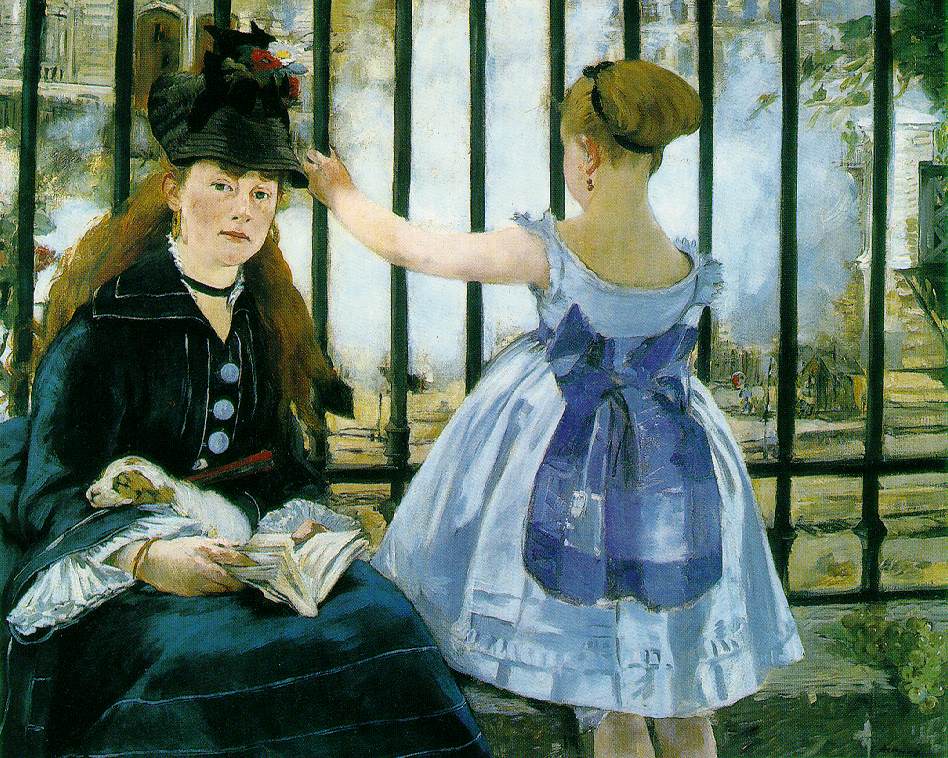
A new piece by Chris Daley in the excellent online journal Alluvium about railway fiction. Here’s the first couple of paragraphs:
Railways are news. On the one hand, they are the source of consternation as above inflation fare rises couple with the perceived drudgery of commuting to characterise the railways as a site of soaring ticket prices and overcrowded, invariably late trains. But this sentiment lives alongside whimsy and romanticism, be it through preservation lines or the restoration of ageing steam engines. This paradoxical image of the railway system is, however, nothing new within the British popular imagination and as Ian Carter (2000) points out, this may have something to do with the railways’ historical link to contested areas of modern everyday life: “So much that we take for granted today was invented or perfected in the nineteenth century to facilitate railways’ development, or to limit their potential for political, fiscal or physical mayhem: standardised time, a disciplined and uniform labour force, large-scale bureaucratic organisation, joint-stock industrial corporations, close State regulation of private capitalists’ activities.”
Similarly, British fiction has maintained an ambivalent relationship with railways. Confronted with a new revolutionary transport system, Victorian novelists offered the most sustained exploration of the potentialities of trains, yet by being, as Nicholas Daly (1999) puts it, ‘the agent and icon of the acceleration of the pace of everyday life’ (463) in the mid-nineteenth century, the railways were also a source for the countless anxieties of industrialisation. Contemporary fiction, in Britain at least, is curiously quiet on the railways, with their appearance often limited to neo-Victorian narratives that attempt to reignite the energy of the steam age. However, to mark the 150 year anniversary of the London Underground, Penguin will release, in March, a series of railway writings that could, perhaps, ignite an imaginative investigation of a transport system that is often seen as mundane, yet is simultaneously a potent symbol of transformation. It is therefore apt to briefly map the terrain of railways in fiction and popular culture in order to anticipate where any future speculation may venture.
Read further at: http://www.alluvium-journal.org/2013/01/12/railways-and-fiction/

Wednesday 31st October, 4.00pm – 5.30pm
Wells Street, room 106
Zara Dinnen (Birkbeck College, University of London)
Did we Miss it? The Legacy of Cyberculture in Contemporary Representations of Digital Technology
It seems today the watchword of the contemporary is augmented reality not virtual reality. As we move toward an increasingly ubiquitous digital culture, are we able to begin to historicise late twentieth century projections for a digital future? This talk will discuss how cyberculture might be perceived as being of a distinct technocultural moment, and the ways that might matter for approaches to our digital present.
Further details as usual at: http://seminarserieswmin.wordpress.com/
Alexa Wright at Digital Aesthetic, Oct 5-6
Tagged as art, technology, visual culture

Alexa Wright is taking part in Digital Aesthetic³ 2012, an international exhibition and conference which explores the impact that the digital has on our sense of self and our relationship to the physical world. The exhibition is housed in the Harris Museum & Art Gallery, and the University of Central Lancashire’s PR1 Gallery in Preston. It demonstrates some of the diverse ways that artists are utilising digital technology, including projection, digital print, 3d work, screen based video work, touch panel installation, and a live interactive website. The conference takes place over Friday Oct 5th and Saturday Oct 6th. In a great line up, other participants include Mark Amerika, Sean Cubitt and Sophie Calle.
Further details at: http://digitalaesthetic.org.uk/
#Citizencurators: collaboration with Museum of London
Tagged as archive, London, museums, technology

#Citizencurators is a history project that will record the experience of Londoners during the Olympic fortnight. Created for the Museum of London, #Citizencurators will collect tweets, moments and images using social networking to tell the story of everyday life in the capital. Directed by the IMCC’s Peter Ride and the Museum of London’s Hilary Young, with a project team made up of students from the MA Museums, Galleries and Contemporary Culture at Westminster, the aim is to investigate how new media/ social networking can provide alternative approaches to supplement contemporary collecting. As action research project, it is also designed to result in knowledge that can assist the Museum in the collection and management of ‘born digital’ material.
#Citizencurators explores what it is like to live in London during the Olympic fortnight (27 July – 12 August). The established narrative of the Olympics is focused on the experience of the athletes, participants, employees and tourists. However a larger part of the Olympic experience in London is not being articulated. This is the daily experience residents whose lives are inevitably caught up in the Olympics but who are ‘bystanders’. What will the Olympics mean to the single mum with a young family in Stratford, the work commuter who uses the Jubilee line, the resident in an apartment block partially occupied by the army, the young club-goer intending to enjoy a summer of fun, the foreign student or to the Starbucks barista? Will the Olympic experience unfold as community-strengthening activity or a headache of disruptions and an overflow of tourists?
To take part, simply tweet like you normally do and use the #citizencurators hashtag. Ultimately by following typical tweeters the team want to collect streams that document peoples’ lives in London during the Games in a way that reflects the normal use of social media, not something out of the ordinary.
For further details, see: http://citizencurators.com/
Nuclear Criticism
Tagged as Europe, Literature, novel, technology, war

Great piece by Chris Daley in the new online journal Alluvium about nuclear criticism. Here’s the first paragraph:
In 1984, the journal Diacritics set out to define what it labelled as the developing academic terrain of ‘nuclear criticism’. The opening section of the journal entitled ‘Proposal for a Diacritics Colloquium on Nuclear Criticism’ established that ‘critical theory ought to be making a more important contribution to the public discussion of nuclear issues’ and proceeded to list a series of nuclear themes that required immediate consideration. Among these were an examination of the nuclear arms race and the ‘dialectic of mimetic rivalry’ it provoked, ‘the power of horror’ and most pertinently ‘the representation of nuclear war in the media as well as in the literary canon’. This last topic was all the more powerful for a mid-eighties audience as the early years of the decade had seen a re-emergence of nuclear anxieties that were reminiscent of the fears twenty years earlier during the Cuban Missile Crisis. The election of Ronald Reagan in 1980 and his subsequent verbal assaults on the ‘evil empire’ of the Soviet Union, energised the ferocious ideological divide between the two superpowers that had ebbed and flowed in intensity throughout the Cold War. Meanwhile, in both the United States and Britain a variety of cultural and media productions speculated on the consequences of such intense political rhetoric. While these texts were predominantly non-canonical and therefore often overlooked by the nuclear critics, they nonetheless question and evaluate the purpose of the nuclear referent in the political power struggle of the Cold War.
Read further at: http://www.alluvium-journal.org/2012/07/01/nuclear-criticism/
Reminder: Thomas Levin on surveillance, June 6th
Tagged as cinema, technology, visual culture

Wednesday 6th June 2012, 4pm
Room 358, University of Westminster, 309 Regent Street, London W1B 2UW
Professor Thomas Y. Levin
Princeton University / IKKM Bauhaus University, Weimar
“Ghostly Surveillance: Some Stabs in the Ciné-Narratological Dark”
Simultaneous with the increasingly widespread use of surveillance as a narrative device in contemporary cinema – its most obvious manifestation being the rise of so-called “real-time” transmission characteristic of CCTV systems in films such as The Truman Show — we are also witnessing a curious proliferation of ghosts within the surveillant machinery, from disturbing videocasettes desposited mysteriously on doorsteps (Lost Highway, Caché) to the re-appearance of people who are supposedly dead on the screens of corporate security systems (Michael Almereyda’s Hamlet [2000]) and the documentation of the presence of demons by means of home surveillance cameras (Paranormal Activity). While it could be argued that at least since Bentham, there has always been a ghostly dimension to surveillance (the panoptic tower functions despite the complete inability to determine whether anyone is actually really inside), what might these ghostly apparitions reveal about the assumptions we make about surveillance images, indeed about cinema as such?
Thomas Y. Levin teaches media theory and history, cultural theory, intellectual history, and aesthetics. His essays have appeared in October, Grey Room, New German Critique, Screen, The Yale Journal of Criticism, and Texte zur Kunst. He translated and edited the critical edition of Siegfried Kracauer’s The Mass Ornament: Weimar Essays (1995). He was part of the curatorial collective responsible for the first exhibition on the Situationist International at the Centre Pompidou, ICA London and the ICA Boston in 1989. Levin also conceived and curated the exhibition CTRL [SPACE], Rhetorics of Surveillance from Bentham to Big Brother which opened at at the ZKM Center for Art and Media Technology in Karlsruhe in October 2001 and edited the catalogue under the same title (with Ursula Frohne and Peter Weibel). His more recent curatorial activities include Anxious Omniscience: Surveillance and Contemporary Cultural Practice (Princeton University Art Museum, 2002), 911+1: The Perplexities of Security (Watson Institute, Brown University, 2002) and The Arts of the Future will be Radical Transformations of Situations, or They will be Nothing’: Guy Debord Cineaste (Slought Foundation, Philadelphia, 2006).
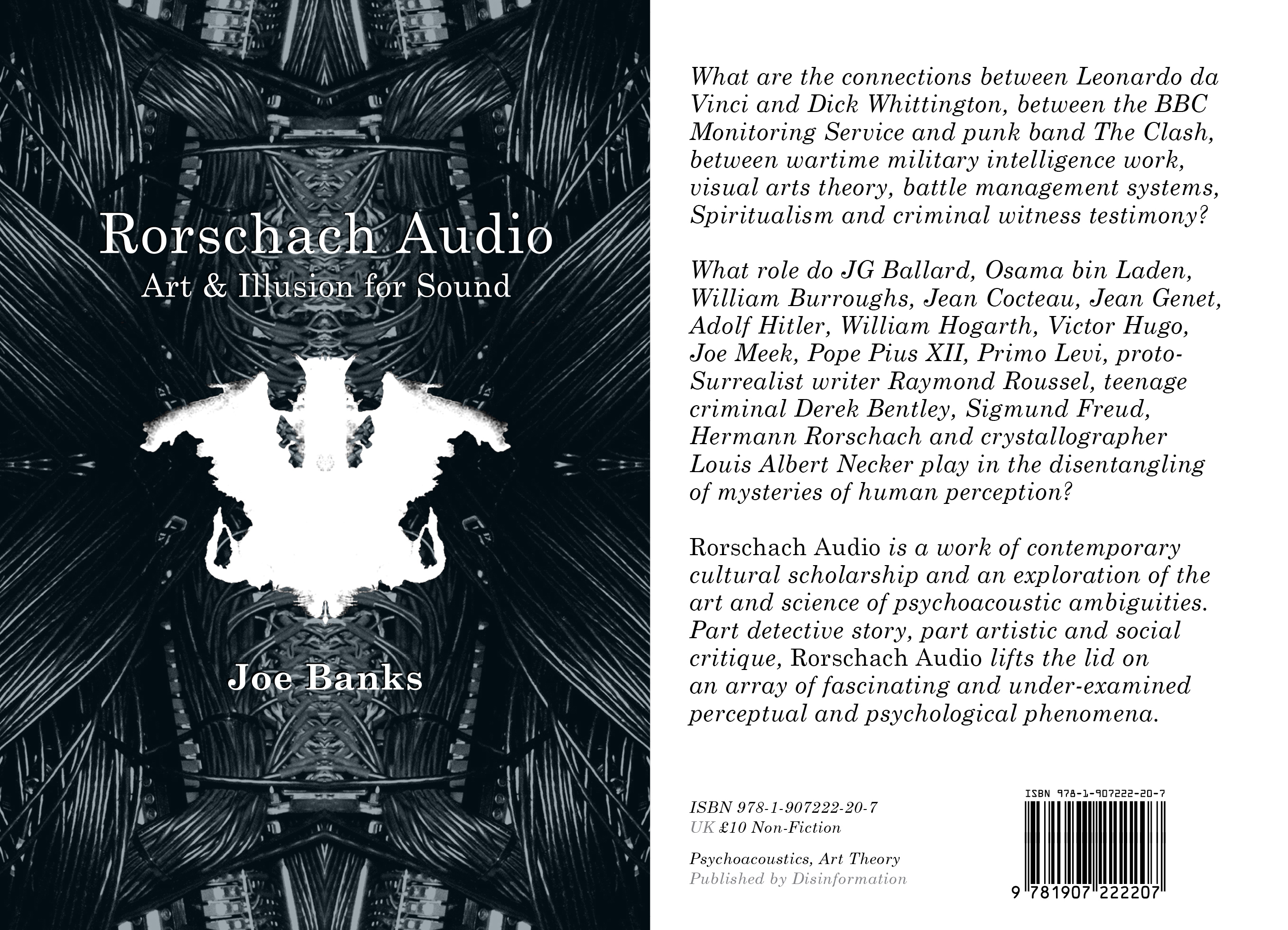
“Rorschach Audio – Art & Illusion for Sound” by Joe Banks – “The earliest form of sound recording technology was not a machine but was written language…” (page 96)
What are the connections between Leonardo da Vinci and Dick Whittington, between the BBC Monitoring Service and punk band The Clash, between wartime military intelligence work, visual arts theory, battle management systems, Spiritualism, radio and recording technology and criminal witness testimony? What role do JG Ballard, Osama bin Laden, William Burroughs, Jean Cocteau, Jean Genet, Adolf Hitler, William Hogarth, Victor Hugo, Joe Meek, Pope Pius XII, Primo Levi, proto-Surrealist writer Raymond Roussel, teenage criminal Derek Bentley, Sigmund Freud and crystallographer Louis Albert Necker play in the disentangling of mysteries of human perception?
“Rorschach Audio” is a work of contemporary cultural scholarship and an exploration of the art and science of psychoacoustic ambiguities. Part detective story, part artistic and cultural critique, “Rorschach Audio” lifts the lid on an array of fascinating and under-examined perceptual and political phenomena.
“Rorschach Audio” is essential reading for everyone interested in air-traffic control, anechoic chambers, artificial oxygen carriers, audio art, bell-ringing, cocktail parties, cognitive science, communications interference, compost, the death penalty, Electronic Voice Phenomena, evolutionary biology, experimental music, ghosts, the historiography of art, illusions of sound and illusions of language, lip-reading jokes, nuclear blast craters, predictive texting, singing hair, sonic archives, sound design, steam trains, tinnitus, the Turing Test, Victorian blood painting, visual depth and space perception, ultrasonic visual music, ventriloquism, voices and warehouse fires and robberies.
Trade distribution by Turnaround
Production by Strange Attractor
Published by Disinformation
ISBN 978-1-907222-20-7
Hardback, 191 pages
UK £10 Non-Fiction
Psychoacoustics, Art Theory
RELEASE DATE MONDAY 21st MAY 2012
Thomas Y Levin seminar at the IMCC, Weds 6 June
Tagged as image, surveillance, technology, visual culture

Wednesday 6th June 2012, 4pm
Room 358, University of Westminster, 309 Regent Street, London W1B 2UW
Professor Thomas Y. Levin
Princeton University / IKKM Bauhaus University, Weimar
“Ghostly Surveillance: Some Stabs in the Ciné-Narratological Dark”
Simultaneous with the increasingly widespread use of surveillance as a narrative device in contemporary cinema – its most obvious manifestation being the rise of so-called “real-time” transmission characteristic of CCTV systems in films such as The Truman Show — we are also witnessing a curious proliferation of ghosts within the surveillant machinery, from disturbing videocasettes desposited mysteriously on doorsteps (Lost Highway, Caché) to the re-appearance of people who are supposedly dead on the screens of corporate security systems (Michael Almereyda’s Hamlet [2000]) and the documentation of the presence of demons by means of home surveillance cameras (Paranormal Activity). While it could be argued that at least since Bentham, there has always been a ghostly dimension to surveillance (the panoptic tower functions despite the complete inability to determine whether anyone is actually really inside), what might these ghostly apparitions reveal about the assumptions we make about surveillance images, indeed about cinema as such?
Thomas Y. Levin teaches media theory and history, cultural theory, intellectual history, and aesthetics. His essays have appeared in October, Grey Room, New German Critique, Screen, The Yale Journal of Criticism, and Texte zur Kunst. He translated and edited the critical edition of Siegfried Kracauer’s The Mass Ornament: Weimar Essays (1995). He was part of the curatorial collective responsible for the first exhibition on the Situationist International at the Centre Pompidou, ICA London and the ICA Boston in 1989. Levin also conceived and curated the exhibition CTRL [SPACE], Rhetorics of Surveillance from Bentham to Big Brother which opened at at the ZKM Center for Art and Media Technology in Karlsruhe in October 2001 and edited the catalogue under the same title (with Ursula Frohne and Peter Weibel). His more recent curatorial activities include Anxious Omniscience: Surveillance and Contemporary Cultural Practice (Princeton University Art Museum, 2002), 911+1: The Perplexities of Security (Watson Institute, Brown University, 2002) and The Arts of the Future will be Radical Transformations of Situations, or They will be Nothing’: Guy Debord Cineaste (Slought Foundation, Philadelphia, 2006).


The Institute for Modern and Contemporary Culture
University of Westminster Department of English, Linguistics and Cultural Studies
32-38 Wells Street, London W1T 3UW. United Kingdom.